

I have always wanted to live in a log cabin. My brother built a beautiful one in the upper field on land my dad gave him on the farm that he inherited from my grandfather. It had a great view of the valley below including my dad’s 100-acre farm. My brother built it mostly himself with help from friends and relatives when he was in his early 20s. I, on the other hand, wanted to be more mobile and travel the country.
I have traveled to every one of the lower 48 states in the U.S. by some type of RV or car, and have also been to Hawaii and Alaska. However, I flew to Alaska and met up with my aunt and uncle, who are retired full-time RVers with a Fifth wheel. They were so gracious and took me on a two-week loop of the state that I will never forget. They slept in their rig, and I slept in a tent, learning how to fall asleep with the sun still up. I really enjoyed that very memorable trip; A drive to Alaska on my bus when I retire is on my Bucket List. Because I like log cabins that I could take on long trips, it was just what I was looking for.
When I moved to southern California in 2004, house prices were sky-high and on the rise. An average three-bedroom two-bath home was selling for $540,000, which I felt was way out of line and that a correction was imminent. Easy to say now, isn’t it? So, rather than buying a house, I decided to continue living in my 1985 36’ Fleetwood Discovery diesel pusher. After hearing more and more about how much safer and more rugged buses are than stick-and-staple motorhomes, I started considering a bus.
My Fleetwood Discovery began having problems, which seemed a bit premature for its mileage and age, so a bus might better suit my needs. I grew up on a farm, and I was drawn to rugged equipment. A heavy-duty, rugged bus conversion seemed like the perfect fit.
I happened on an MCI-7 that was for sale in the RV park where I was staying, so I bought it and put my Discovery up for sale. It took about three months to sell the stick-and-staple unit, but it found a happy home with a young family who had looked at many motorhomes—it was just what they wanted.
I had my MCI-7 Combo, which, for its time, had a lovely interior. I owned it for about three years, but I still had my eyes on a Log Cabin Bus that was for sale. I liked the log cabin look and feel, and the larger windshield and windows in the MCI-9 looked very appealing compared to my older model, the MC-7, which had smaller windows. The previous owner of the MC-9 Log Cabin Bus offered to trade my 1972 MC-7 conversion and my Harley, and a bit of cash, for the Log Cabin Bus, so I decided to take him up on his offer.


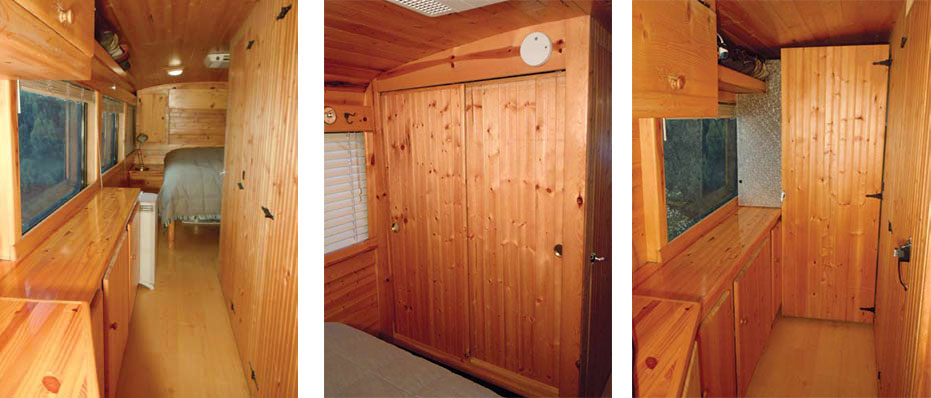
Again, I like the rustic look and feel of a log cabin, with lots of wood, which is easy to clean, and no carpets to gather dust that requires deep cleaning. Due to my allergies, I am not fond of dust, and an allergist will tell you that carpets are excellent dust collectors. I also don’t like having to take off my shoes every time I walk into my home, as some folks with high-end units insist on. I never thought a carpeted motorhome made much sense when you spend a lot of your time in campgrounds where you frequently have to walk through grass or gravel to enter your abode. To each his own.
The first thing I did was remove all of the dead animals hanging from the walls. I do like the rustic look, just not the rustic feeling. The animal heads and hides on the walls were just dust catchers to me and I knew they would wreak havoc with my allergies. I also removed the gun from the wall, the traps, and pictures of hunters in the wild. I had heard from someone who previously drove the bus that it was very noisy going down the road because of all of the wall ornaments banging against the wood. I decided I wanted a quieter ride.
After removing everything, we relocated the stove/oven and the small counter and lower cabinet on the driver’s side 24 inches forward and installed a Splendide washer/dryer combo unit in that space. The Splendide combo works great, but you must be gentle with it. The door latch can easily break if you close the door too hard.
Being a bachelor, I don’t even sweep my wood floor; I have a robot that does it for me. His name is Roomba, and I just set him on the floor. He starts spiral motions and branches out until he bumps into a cabinet or other object, just like my neighbors’ blind dog. Then he backs up, makes a bit of a turn, and goes in another direction until he bumps into something else. It takes him about 30 minutes to randomly vacuum the entire bus floor. Now and then, Roomba gets hung up on something, but he can usually back up, turn, and go in another direction to free himself, and he generally does quite well. He even cleans under the bed and sofa, which is difficult to do with a broom or conventional vacuum cleaner, but is important for someone with allergies. My next bus will have curved inside corners to match his radius, so there is not a pile of dust bunnies in all of my corners. After he has finished his cleaning, I pick him up, open his small bin, dump out the dust, dirt, hair, and other objects he has swept up, wipe him off, plug him back in, and set him on his shelf, where he awaits his next call to duty. A flat wood floor is ideal for a robotic vacuum cleaner.
I added a built-in wastebasket compartment because I don’t like having to open a cabinet door every time I want to throw away a paper towel; that never made much sense to me. I built it to hold a large trash can because I don’t like taking out the trash either. So I picked up a large Rubbermaid Deluxe Slim Jim trash can with a 16-gallon capacity, which measures 11” x 23” x 25” tall. I built a cabinet around it and cut a six-inch diameter hole in the top of the cabinet, so that most things I discard, except a gallon milk jug or a cereal box, will fit through the opening. I figured that once a week, when I have something larger to dispose of, I could open the front access door and slide the wastebasket out partway. I always use heavy-duty plastic trash bags and keep the roll at the bottom of the wastebasket, so when I take out the full bag of trash each week, I don’t have to search for the bags. I can usually go a week with one trash bag, but in the summer, I empty it more often.
When I bought the Log Cabin Bus, it was designed as a display model and built by a highly skilled craftsman with extensive woodworking experience; it was very well-crafted. However, it was built for weekend trips with little closet space. It had only one closet that was only three and a half feet long, a small fridge, and no washer/dryer unit. I wanted to live in my bus full-time, which I did for the past five years in my Discovery and for three years in my 1972 MCI-7, so I had a clear idea of what I wanted. Before I drove the Log Cabin Bus off the lot, I made a deal with the previous owner; he would supply me with a handyman and allow me to use his large lot and we would make some changes to convert it to a full-time bus.
We built a two-drawer file cabinet out of wood, of course; I like to keep my current files close at hand. As it turned out, the placement was perfect—all I needed to do was turn 90 degrees counterclockwise in my office/kitchen/dining room chair from my office/kitchen/dining room table, and my files were right there. He also added a four-cubic-foot apartment-style refrigerator with a small freezer, as the fridge that came with the bus was too small for full-timing. I figured that when I go boondocking, I could fill both refrigerators before heading out on a trip. When I started running low on food and beer, I could turn off the smaller unit and consolidate everything into the larger three-way (propane/110V/12V) unit, allowing me to run off propane and conserve power.

I use a microwave oven for all of my gourmet cooking. This bus didn’t come with one because when you take only weekend trips with a family, you usually cook outdoors. However, as a full-time bachelor, I needed a microwave oven. I selected a medium-sized unit with the most straightforward controls I could find and constructed a cabinet to house it. Some folks just set them on the counter, but if they ever run into anything driving down the road, the microwave would be embedded in their skull. I don’t like bloody messes. Building it in prevents it from becoming a projectile during sudden stops.
The Log Cabin Bus did not come with any roof A/C units, only the primary central over-the-road system. Because I stay parked most of the time, that didn’t suit my needs; I need two roof air units in Southern California. I went with the taller Coleman Mach series 13,500 BTU unit. I really wanted a Duo-Therm Penguin Low Profile unit because I like the low-profile look, but I had one before, and it generated a high-pitched noise, which I didn’t like. I thought it might be the one unit I bought for my MCI-7 that was bad, but I spent some time at Camping World listening to different A/C units running. Every one of the Penguins I listened to had the same high-pitched background noise, so I decided to go with the Coleman, which has been good to me.


This bus also did not come with a generator, but the previous owner said I could have a used one he had in his shop. However, I could not get the Chinese-built generator to run and also heard bad reports about them, so I took my Onan 7.5 KW that had given me three years of carefree service in the MC-7 out of my old bus and put it in my Log Cabin Bus. It is a bit noisy as it is an older model from back in the 70s.
The bus came with a 30-AMP service but was wired to be upgraded to a 50-AMP service. So, I bought a 50-foot, 50-amp cord and wired it for 50-amp, 220-volt service. I hardwired the cord into the breaker panel. In my next bus, I like the idea of a power cord with male and female ends at both ends, similar to an extension cord, which is removable. This allows for easy storage in any compartment, rather than being limited to the power control panel compartment. This also gives you the advantage, as I learned from Wulf Ward who wrote an article about shore power cords, that you can use the 50 AMP power cord when you really need to draw that many AMP’s, but can use a 20 AMP lighter, more flexible, easier to handle power cord when you are just doing an overnight and not running the A/C. This seems like the ultimate solution to me.
I was concerned that someone might steal my cord if it was just plugged in at both ends. Still, my design featured the outlet on the inside of the baggage compartment, exiting through a hole in the floor, positioned in such a way that it cannot be easily unplugged and stolen. This is the best of both worlds. I have two different receptacles, one for 20 AMP and one for 50 AMP, to avoid dealing with adapters, which can sometimes be a hassle and are easy to lose or steal. The dual system will also allow me to plug in my 50-AMP power cord and my 20-AMP cord if I need to run three roof air units simultaneously, and I wired the bus accordingly.
Because the bus was designed only for weekend trips, it had only about four outlets in the entire bus; one in the front, one in the bathroom, one in the kitchen, and one in the front of the bedroom. There were none in the back of the bus, except for a reading light, an electric blanket, or anything similar. As an electrician, I immediately doubled the number of outlets.
Another problem I encountered, naturally, is that the power panel was only designed with eight 110V circuit breakers. After using up two breakers for each A/C unit, I was left with only six breakers, with many circuits remaining. I went out and picked up a four-switch breaker sub-panel that I use for the microwave and the washer/dryer unit. I occasionally trip a breaker due to the numerous modern appliances and everyday electronics I have, just like everyone else. As mentioned earlier, this bus was designed as a weekend getaway, not to live in full-time, so changes had to be made.
My next bus will have at least twice as many outlets and twice as many circuits. I also added a 12V license plate light on the ceiling to illuminate the control panel at night, so I can see the breakers, as there are no light switches in the bus, only switches on each light and the main circuit breaker switch. I connected the license plate light to the refrigerator circuit, so if that circuit went off, I would know right away that the fridge was not getting power, allowing me to take corrective action immediately if necessary. The idea of the original bus was to keep it simple, which works well for weekend trips. My next bus will also have a dedicated circuit for the refrigerator, so there is no chance that another outlet will trip the breaker.


The bus came with only two house batteries. Because I enjoy getting out and boondocking in areas where most people don’t go, and I dislike the sound and exhaust of a running generator, I needed more storage capacity. The previous owner also only had a 750W inverter, so that wouldn’t do either. I bought a rebuilt ProSine 3,000W Inverter/Charger and installed it with four 6V batteries. I initially wanted to use eight batteries, but due to the baggage compartment layout, it would have been challenging to service them all without constructing a slide-out tray. I also wanted to use no-maintenance AGM batteries, as I had in my Sportsmobile, but they had become too expensive by then. In my next bus, I will make room for eight batteries and may go with the AGM if I can afford it.
I relocated the two seven-and-a-half-gallon propane tanks to another baggage compartment so I could relocate the four batteries that were previously occupied by the propane tanks. I also put the inverter in the same bay as the batteries. It is not a good idea to have the propane tanks in the same compartment as electrical components that may occasionally spark. The propane tanks are portable rather than built-in, which I like much better. There were days when I had the Discovery with the large built-in propane tank that required driving the coach to get the tank filled. I spent an entire winter in the Discovery in New Hampshire, and with two furnaces, it went through quite a bit of propane. Having to put all my stuff away to make a trip to the propane filling station was too much of a hassle for me, especially when it was no degrees outside, which was often the case in the middle of winter.
I am considering installing four propane tanks on my next bus, allowing me to go longer between refills. Fortunately, where I live now, there is a propane delivery service that comes by on a regular schedule, so that is very convenient. Occasionally, I use a bit more propane than planned, such as when my aunt and uncle visited for a couple of months last winter. My aunt is an excellent cook and cooks most meals from scratch, so we went through about double the propane I would on my own. I generally can cook anything I need in the microwave, but that doesn’t taste quite the same as my aunt’s home-cooked meals.
When we ran out of propane, all we had to do was remove the two portable tanks and run to the propane filling station about a quarter-mile away. This was a bit of a hassle, but not as much as driving the bus there and navigating around the cars at the gas station to get to the propane tank filled. The other thing I will have on my next bus will be a remote propane gauge to monitor the level better. Bending down and crawling into the baggage compartment to look at the gauges is not very convenient.
I also installed a Kingdome Satellite on the roof. It is not in-motion for two reasons: I travel alone or with one person most of the time, so there is no need to watch TV while driving down the road. Additionally, I believe people should be enjoying the scenery rather than watching TV while on the road; this is my opinion. The other reason is that it was also out of my price range. However, I did get the automatic satellite seeking feature, as trying to crank up the manual dish and dial in the appropriate satellite using a compass every night when traveling is too much trouble.
I upgraded to HDTV when my DirecTV satellite contract expired and had a dish installed on the ground because, for the most part, I am stationary right now, and the roof-mounted HD dome was definitely beyond my budget. However, my next bus will have an HD dome; by then, the price will come down significantly, and I will be retired, traveling a lot more, so a stationary satellite will be out of the question. Even though it is nice to have a portable satellite antenna in case you are parked under trees, they come in handy, but they increase your cost somewhat and take up space, along with the coiled-up coax cable, in your luggage bays.
This bus has only one propane furnace because it was designed for use only on weekend trips in Southern California. My Discovery had two furnaces and was a four-season rig. Two furnaces provide backup in case one fails, and two will take the chill off faster in a cool climate, allowing you to travel in colder regions, provided that heat can be supplied to the luggage bays where the water tanks are located. My Log Cabin Bus also lacks insulation, aside from the insulation provided by MCI, and features single-pane windows. When it gets really cold out here in SoCal, with temperatures below 60 degrees in the dead of winter, two small 1,500W electric heaters, using only the over-the-road bus insulation, can maintain the bus at a comfortable temperature. This would not be adequate for northern states in the winter.
I use the furnace to warm it up when I first come home from work and when I get up in the morning to give the electric heaters a boost. In the heat of the summer here, when temperatures reach above 100 degrees during the day, my two 15,000 BTU roof A/C units can barely keep up. My next bus will have two furnaces, three A/C units, and will be fully insulated, with hopefully double-pane windows. My bus has all of the windows just like a passenger bus. They were covered over with plywood on the inside, with the window side painted black for the bathroom and the kitchen areas. It appears to be a regular passenger bus from the outside, with factory-tinted windows. Having so many windows makes the bus very bright on the inside, and with the light-colored wood, it is one of the brightest buses I have been in. The problem with having so many windows is that it feels chilly next to the windows when the temperature dips. Another problem with having so many windows is that they also let in a lot of dark at night, so additional lighting is required.
The bus came with log cabin furniture, including a log cabin sofa, two log cabin chairs, and a bed made from round pine logs. The look was rustic and suitable for a weekend, but it was very uncomfortable for full-time use. I removed the sofa and chairs and sold them, and bought a wicker love seat from Pier 1 Imports, which is not only very comfortable but also lightweight. The only other chair in the bus is a very comfortable office chair with wheels; I am limited to how large a party I can throw.
The side opposite the love seat is reserved for my treadmill, which I use while watching the news in the morning and reruns of History Channel and Discovery Channel shows I’ve recorded on my DVR. I no longer watch live TV; I record everything and time-shift it for when I want to watch it. I never liked watching commercials, and lately, more time is spent showing commercials than the news.
In exchange for my aunt and uncle taking me around Alaska back in 2002, I invited them to come out to California and stay with me for two months last winter to escape the cold and snow in the Great White North of New Hampshire. They were full-time for about seven years until their health brought them back home. My uncle is a master carpenter who built two houses all by himself. He does excellent cabinetwork and built another set of cabinets in the rear of my bus over the bed. They matched the rest of the bus perfectly. Now, in addition to the three and a half feet of closet space, I have four more cabinets to store my socks and skivvies.
The bottom line is that I love my bus and love being a Full-Timer. Without slides, the kitchen can feel a bit crowded when I have company over, but with careful timing, two people can pass by each other when the stove is on. My next bus will be built based on lessons learned from this bus, my previous bus, and my Fleetwood Discovery. It will feature more lighting, additional outlets, expanded closet space, solar panels, two propane furnaces, two 10-gallon propane/electric water heaters, and built-in electric heaters for use when parked in an RV park.
It will have 200-gallon fresh and 200-gallon grey/black tanks, similar to my MC 7, or larger if they fit in one compartment. Both will feature three-inch dump valves, enabling a fast dumping procedure and reducing the need for frequent stops while traveling. I want six-inch dump valves, like the ones on the fire truck tanker I used to drive, which would really expedite the evacuation of the tanks. However, that is probably not feasible since we are limited to dump stations that still have three-inch receptacles.
This bus is great as it is for most people and would be excellent for people with kids; it is challenging to mess anything up with the wood ceiling, walls, and floors. But my next bus will have more goodies to suit my lifestyle better. It will likely be another Log Cabin Bus; they are easy to keep clean. I would also like long-range fuel tanks that hold 300 gallons, like my friend with the Newell, but that may not happen. But it will definitely be better equipped than this bus for Full-timing and for long-term boondocking. Slides would be nice, but not a necessity.
I have considered a 45-foot bus, as that would be roomier, but I like traveling on the red roads, so that might limit my travel to some of the remote locations I enjoy. I don’t care too much for interstates. My reason for traveling when I retire will be all about the journey, as well as the destination. My next bus will likely be my last. And it will be configured to have everything I need. I have based my research on 20 years of back issues of Bus Conversion Magazines that I have read. These are filled with tons of helpful advice and experiences from buses of all types. I will also draw on my own experience with living and traveling in a variety of campers, motorhomes, and bus conversions over the years.
I hope to see you all at the upcoming Rallies and to pick your brains for more ideas about planning my next home on the road.