






No products in the cart.

Daniel Lenz
October 16, 2025
82 views
Unusual Odors and Sounds
Using your sense of smell when driving or walking around your bus is very important, right up there with using your eyes and ears. Recognizing specific smells in and around your RV can not only save your rig but may also save your life. Experienced bus and truck drivers and mechanics are already aware of this.
One of the things you should learn, if you haven't already, is the difference between the smells of, for example, overheating brakes, a hot clutch (if you have a manual transmission), gear oil, engine oil, transmission fluid, slipping or burning belts, antifreeze, and hot electrical components. Knowing the differences may alert you to a problem that you can resolve before it leads to a catastrophic failure somewhere down the line.
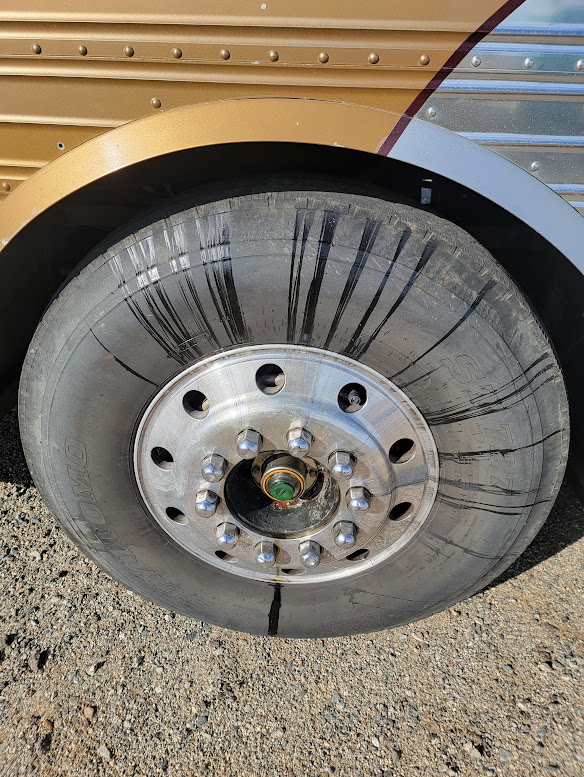
For example, while driving for Neil this past September in his bus conversion, we were beginning the last day of our trip back to California, about a 400-mile day. As usual, I was doing my walk around of the bus, i.e., my pre-trip inspection; checking fluids, lights, etc. As I walked past the right rear drive axle, I could smell gear oil, indicating a leak from the inner wheel seal. Just by looking at the outside of the duals, there was no indication of an oil leak. But after I popped my head inside the wheel well, I could see the inside tire was wet with gear oil. Gear oil smells different than most other oils.
We were supposed to leave at 8:00 a.m. that day, but I told Neil we needed to get going earlier because the inner wheel seal on the drive axle was leaking. It was about 7:00 a.m., and I had already called a nearby truck stop so we could get it in and at least have the differential fluid topped off before we hit the road. This would also inform me of the severity of the leak and whether I could return the bus to California safely or not.
Before we left, I was preparing the bus, dumping the grey and black tanks, filling the fresh water tank, taking down the blinds, and all the things you do to start the day fresh on the road. While I was doing that, Neil went back to check the leaky seal for himself. He came back to me and said, “Dan, how do you know the wheel seal is leaking? I didn't see anything.” To which I replied that I could smell it while doing the walkaround.
So, we went back there together, and I said, “Stop right here” when we were right in front of the drive axle. I asked Neil if he could smell anything, and he replied that he could. What is that? I said that's differential gear oil, and if you look inside the wheel well, you'll see that the inside tire is wet, indicating a leaking inner wheel seal.
Another example: My good friend Jim King had a 1983 Eagle that I worked on frequently some years ago. He was getting ready to embark on a 40-some-day tour from here in South Texas, heading up into Washington State and then crossing through the central part of the state en route to Tennessee, which is quite a long trip. We boarded the bus and prepared for the long journey.
While he was in Washington, preparing to play a gig, he called me on the phone and said that the brakes wouldn't release and the bus wasn't building air pressure beyond 60 psi. I asked him to shut the bus off and pump the brake pedal until he had zero air pressure, then restart it. Sure enough, it built air pressure up to 120 psi. This indicates the purge valve on the air dryer needs to be replaced.
I then instructed him to release the air brake, apply the brake fully, and remove his foot from the brake pedal as quickly as possible. I was still on the phone when he tried to release the brakes, and he said it still wouldn't move. I said yeah, because you didn't do it right. He said, 'How do you know? You're 3,000 miles away from me and just on the phone. I said, 'I could hear it, and you didn't do it right, so try again and do exactly what I told you to do. I want to hear it pop when you take your foot off the brake pedal. It worked fine after that, and he had the air driver replaced after that trip. His bus has aired up correctly ever since.
Another common problem with older buses, which often have older engines with thousands of miles on them, is that they tend to overheat while climbing long grades. A bus with a rear engine does not receive the same airflow as a tractor-trailer, which has its engine positioned right up front, sucking in all that fresh air. In contrast, on buses with rear engines, it can be challenging to keep the engine cool during prolonged, strenuous pulls.
If you shift down and maintain a higher RPM during the climb, you should be able to make it over most hills. However, if you are climbing a long grade and smell and taste antifreeze, stop the bus immediately, as that indicates either the overflow tank is spitting out coolant or you have sprung a leak in a radiator or heater hose, which requires immediate attention. It doesn’t take a hill to spring a coolant leak; it can happen on flat and level ground if a hose breaks or a hose clamp comes loose. When that happens, you can usually smell and taste antifreeze; it's time to pull over and look for a leak.
Additionally, if the coolant comes into contact with the turbo or exhaust pipe, it can ignite and start a fire. That happened to Gary Hatt’s bus a couple of years ago after he replaced his thermostats at a friend's house in Denver. He was climbing a hill out of Denver, and all of a sudden, he could smell and taste coolant.
He stopped the bus as soon as he could find a safe place to pull over, shut the engine down, went back, and opened the engine compartment, immediately noticing that the coolant that had sprayed on the insulation around the turbo was on fire. He went back inside the bus to grab his fire extinguisher, which he had just inside the entrance door, and knocked most of the flames down.
However, when the extinguisher was emptied, some of the fire was still burning, so he returned to the bus to retrieve a plastic gallon jug of drinking water. He went back to the engine and squeezed the water out of the bottle, flooding the insulation until the fire was completely extinguished. He found that a radiator hose had started slipping off the oil cooler under pressure and was spraying coolant all over the turbo. Recognizing the smell of antifreeze and the bitter taste in the air can save an engine or even an entire bus.
This spring, a friend of Gary’s had just left a beach in Mexico; he in his Eagle bus, and she was in her converted van. She had an oil leak before entering Mexico, but the dealer claimed it had been fixed. However, her engine light would come on and then go off intermittently in Mexico and the engine smelled hot. She went to AutoZone, where they read the codes, which indicated low oil pressure. She then added oil and continued her trip.
On their way back from a beach in Mexico to the States, they stopped just north of town to wait for everyone to regroup, and she said her engine light was coming on again. Gary said, “Let’s check your oil level”, and sure enough, it was not even showing on the dipstick. She drove back to Auto Zone and had the guy add another gallon of oil. She came back to catch up with the rest of the group, and Gary rechecked it. It was barely touching the bottom of the dipstick, so they poured in another two quarts.
In the meantime, Gary called back to a friend who was still in the campground and asked her to go over to where she was parked and look for an oil puddle. The friend in the campground said there is a place that looked like oil had dripped in the sand, and she felt oil, but because she was parked on the sand, there was no way to determine exactly how much oil she had lost, as most of it ran deep into the sand.
Therefore, examining the size of a puddle is not always an indication of the severity of the problem, unless your rig is parked on a concrete or other non-porous surface. Bottom line, she made it to the border and then added another quart of oil before heading to the dealer in Phoenix, who fixed the same problem he had fixed the first time. He had to replace her oil cooler for a second time, which is a known issue with this model van.
Again, I want to stress to RV owners that they should always walk around their rig, look on top and under it, and ensure there are no wet spots or any unusual smells. Large vehicles just can’t pull over on the side of the road as easily as a small car if a problem occurs. If, however, you spent the night in a truck stop and woke up next to a cattle truck, and something smelled bad, then that is different. LOL!
These are just a few examples of what you may encounter when driving any rig. If you have never worked in a garage, it would be a good idea to visit an auto repair shop and ask the mechanic to let you smell the different liquids he has in his shop. It may take some time to differentiate between the smells, and you will learn from experience over time.
However, if you experience any unusual smells or sounds while operating your rig and are unsure of the cause, find a shop that can identify the issue promptly. Discovering and repairing the problem is almost always less expensive than waiting for a failure to occur and having to replace parts. And keep in mind, if a failure occurs while away from home, you are at the mercy of the shop owner to treat you honestly.
Once you learn to recognize the different smells and sounds, you will be able to remember them. Noticing something that doesn’t smell right or doesn’t seem right can save you thousands of dollars in repairs down the road. If you notice a wet spot under your rig, inspect it to determine its cause before driving away. By examining the color, smelling it, and tasting it if necessary, you should be able to determine what is leaking. Then, you need to determine where it is leaking from. The size of the puddle will indicate how much has leaked while the vehicle was parked there (unless, again, you parked on a sandy beach). That will determine how urgent it is that you resolve the issue.
A walk around your rig and looking for any puddles under it is part of any pre-trip inspection. Catching a problem before you hit the road can not only save you some money, but may also save a spoiled vacation.
Article written by Daniel Lenz
Daniel started in the bus industry back in 1976 when his parents purchased a school bus operation which included one motor coach in Minnesota.
Around 1979 the family expanded the operation of motor coaches, choosing to operate Eagles, their motor coach of choice.
In March of 1986, Daniel was offered a job working for Eagle International's production facility in Brownsville, Texas as their Customer Service and Warranty Coordinator. He progressed into other positions such as Field Service Technician/Trainer, Quality Control Manager and lastly Production Manager.
Daniel has a Facebook group called "Silver Eagle Bus" https://www.facebook.com/groups/silvereaglebus/ that has grown to 11,500 members, keeping the history of the Eagle buses alive and well.
Daniel also enjoys traveling worldwide with his life partner, Elvira, from Germany. Elvira supports the passion for the bus industry that Daniel grew up with; a great match for sure. Just as important is spending time with his Daughter Ashley, along with her Husband Nick, and their little puppy Basil.
To be the first to read all new articles and to read thousands of articles about conversions back to 1992, become a member of BCM.
Click HERE to become a Member now!Click on any image in this column
to open the company's website.
to open the company's website.
