What Type of Vehicle Is Best for Traveling and Camping?
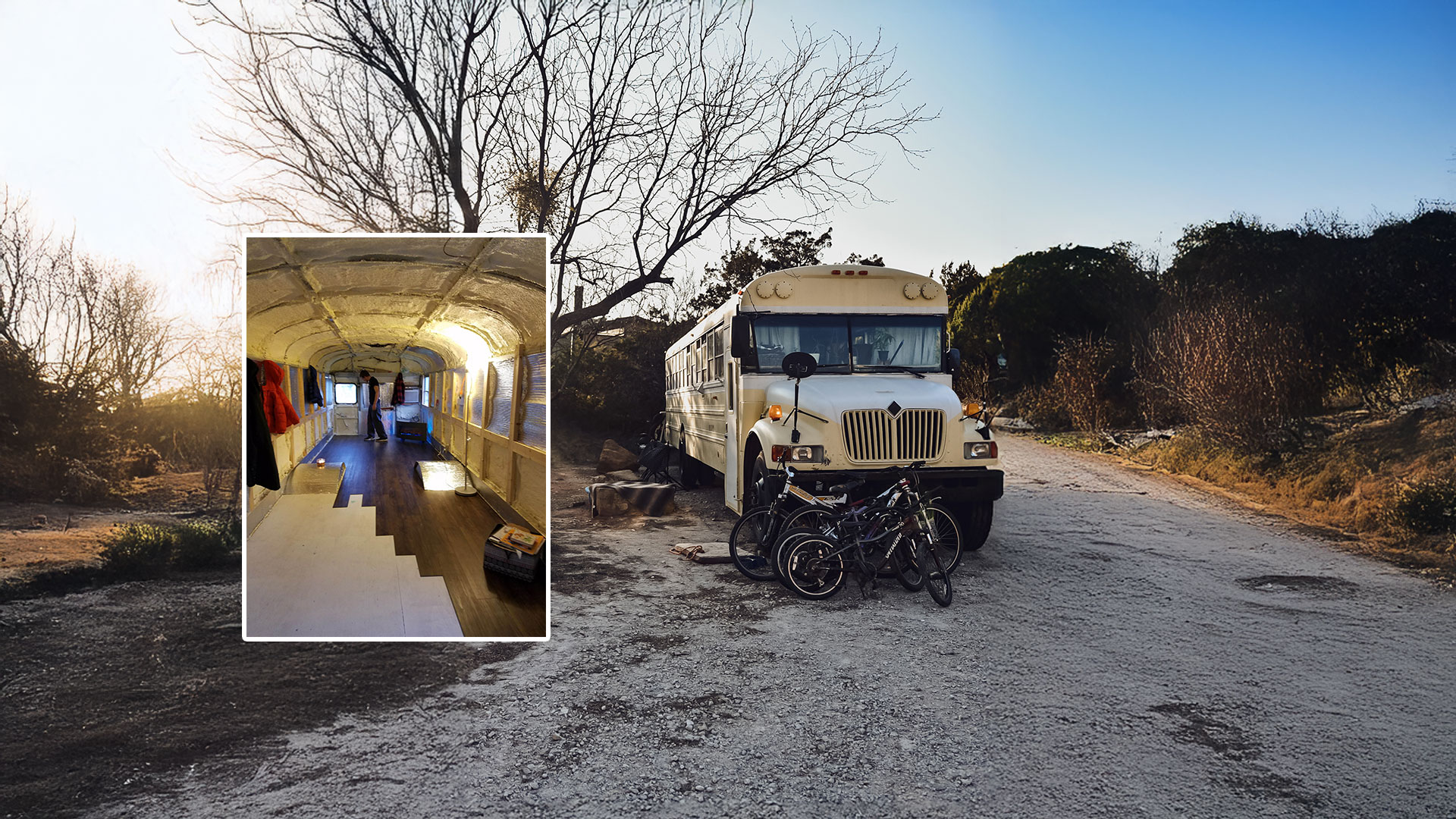
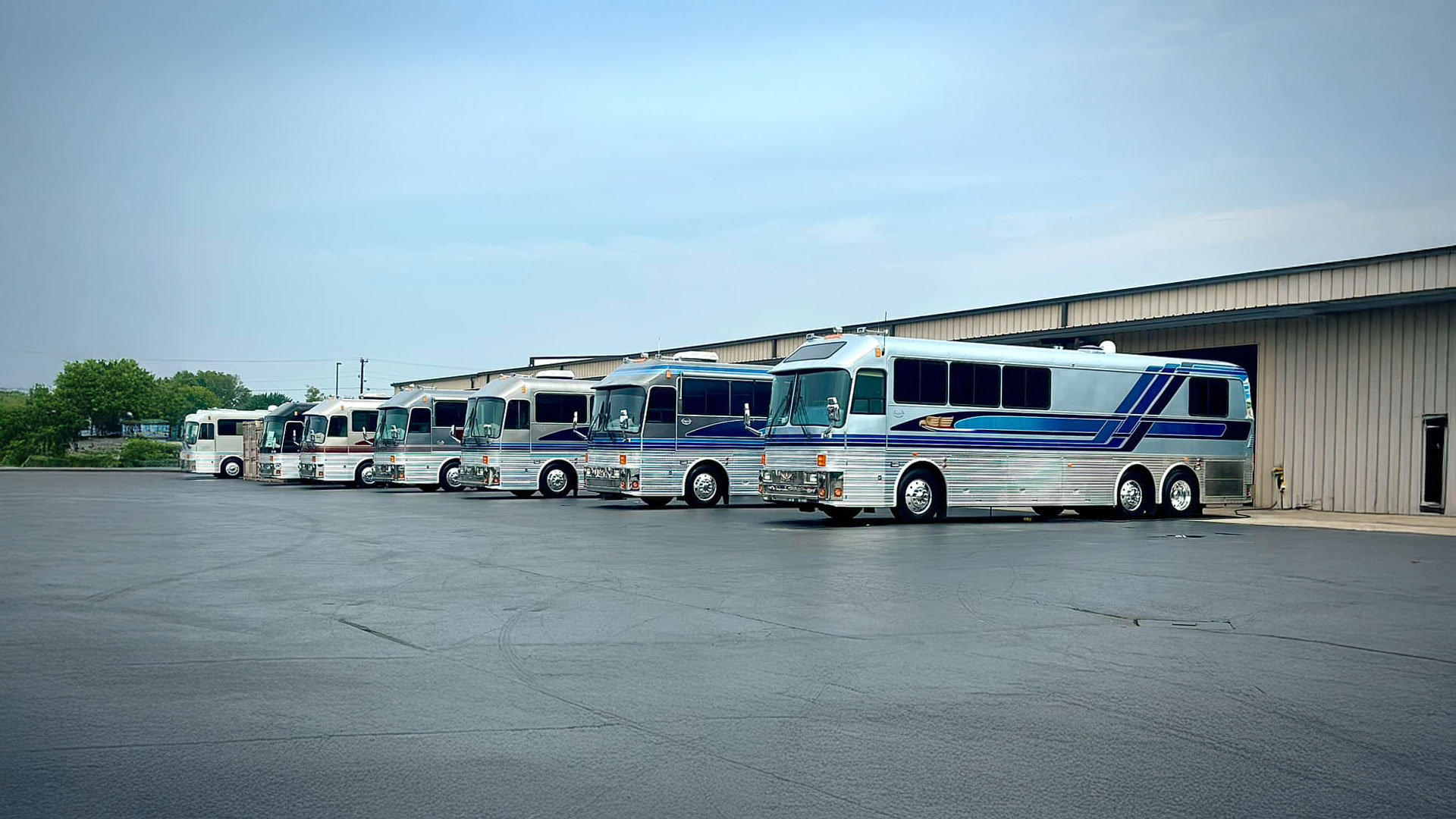
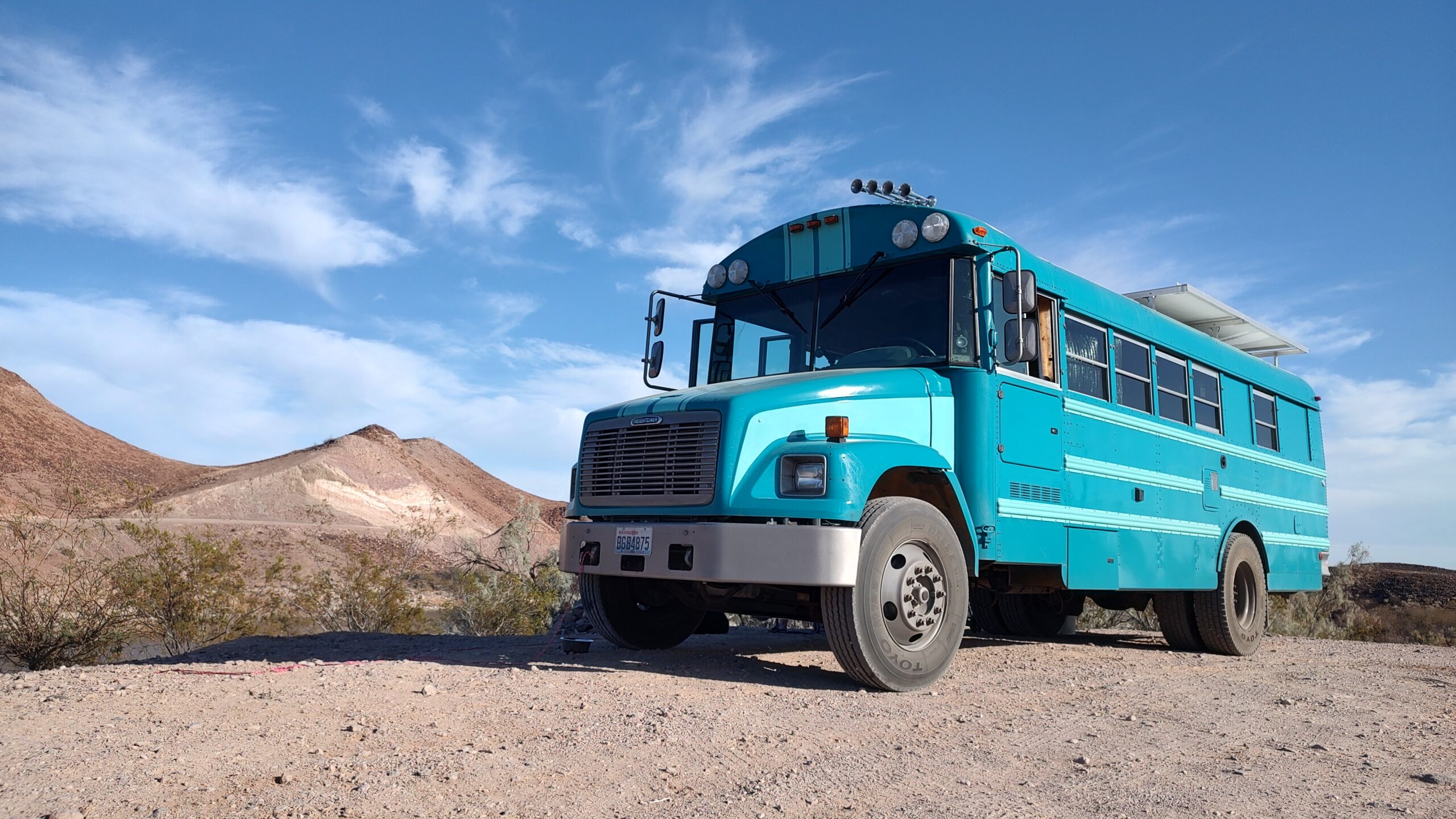
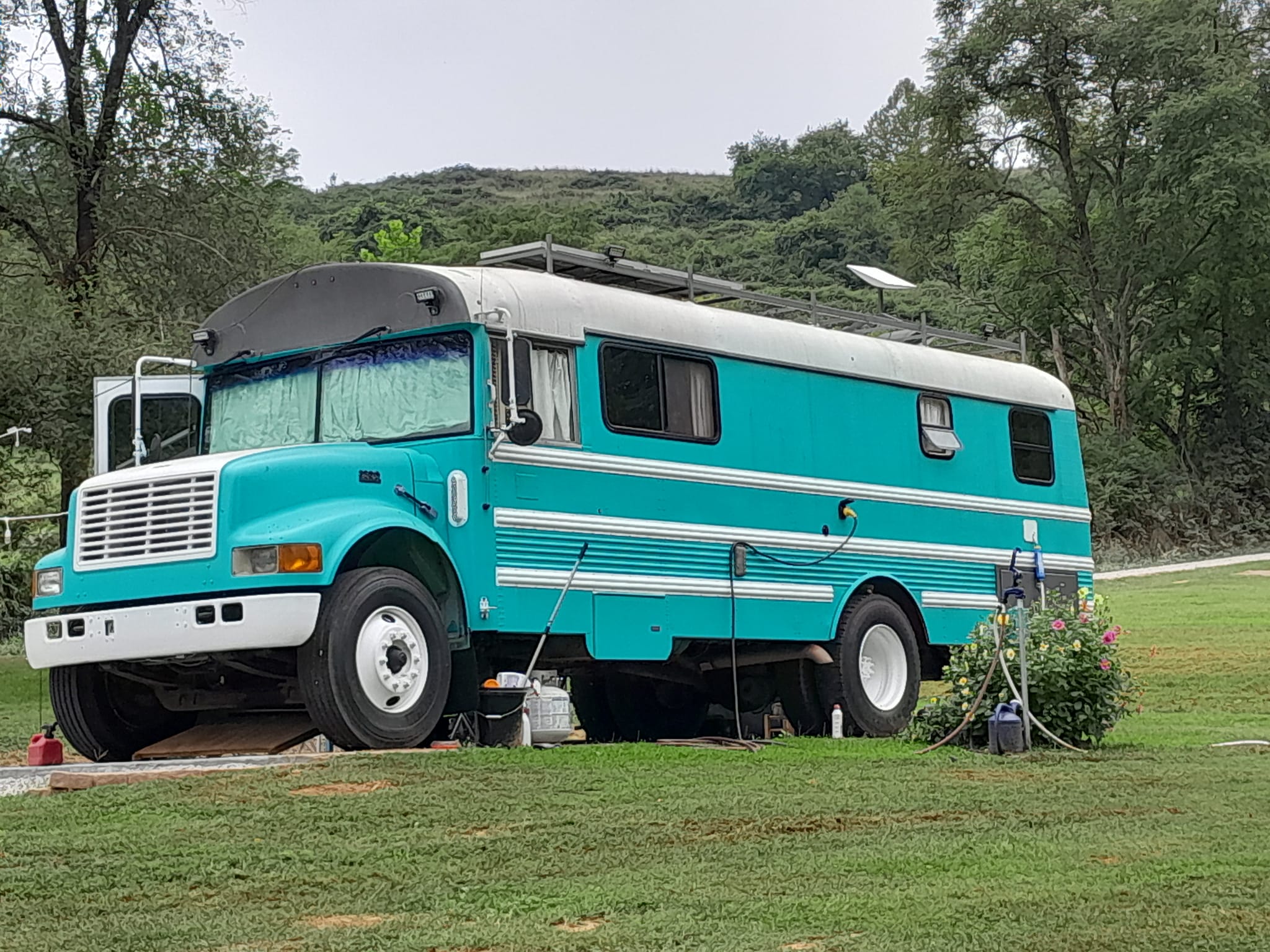
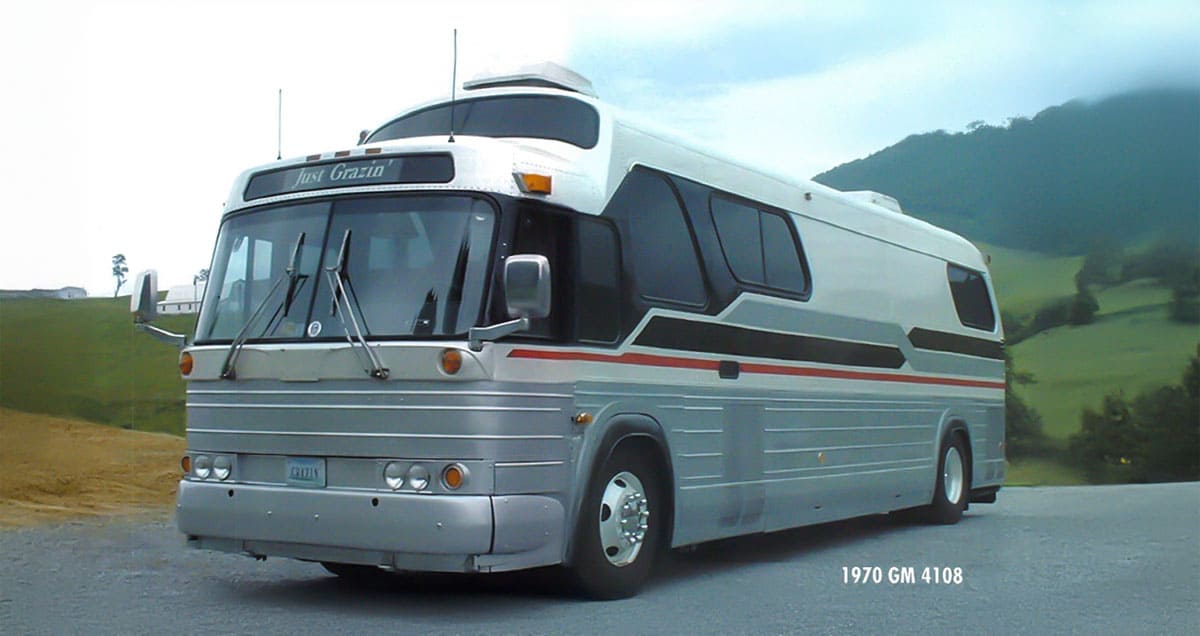
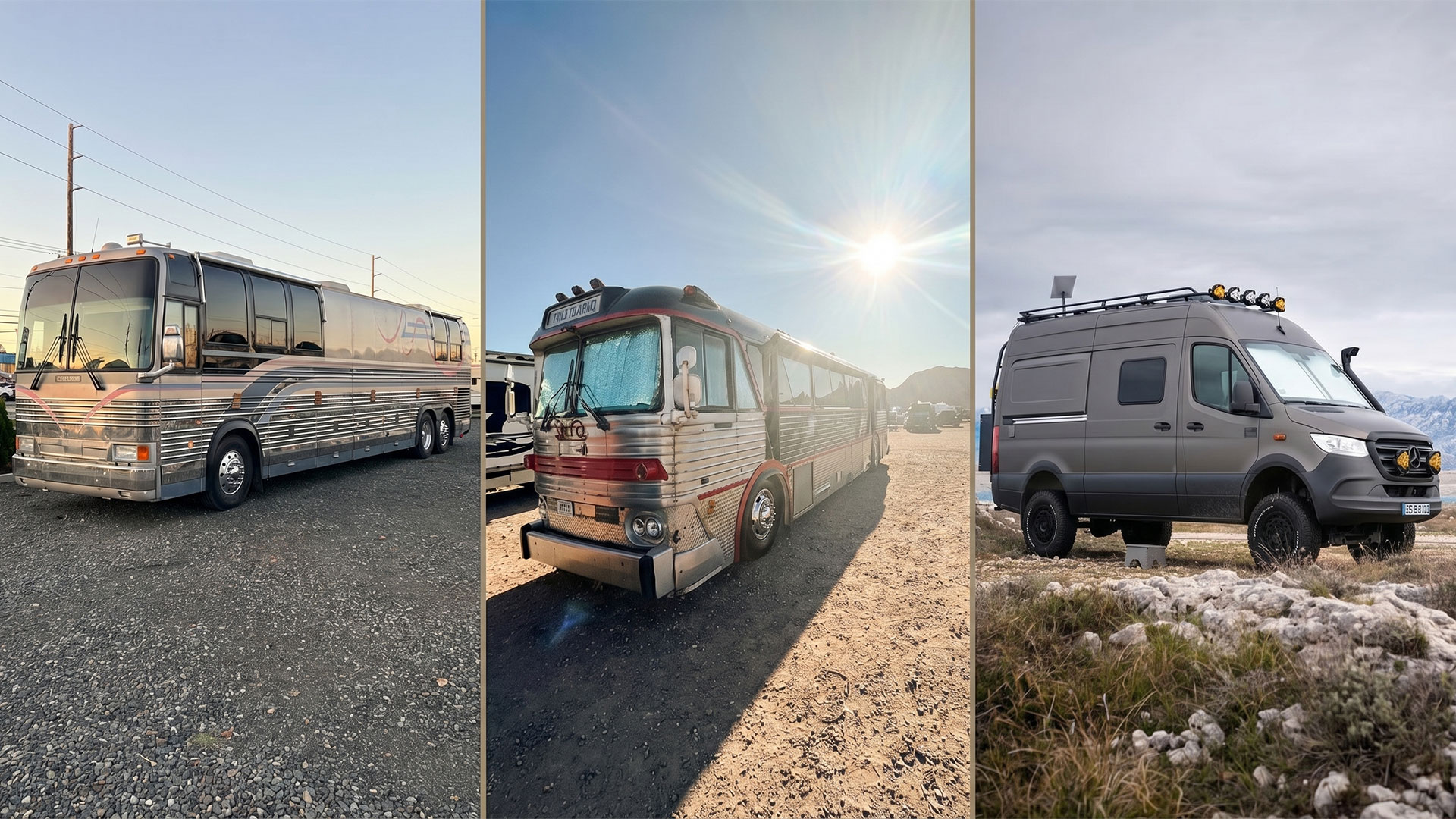
Van-based campers (Class B motorhomes), Skoolies (school bus conversions), and tour buses, also called Entertainer Coaches (often converted into Class A motorhomes), are three of the most popular conversion platforms. For this discussion, we will narrow our selection to these three vehicle types.
Each has its strengths, but choosing the right one begins with understanding your lifestyle, your budget, your comfort level, and the realities of the road. That’s the question, and it’s not as simple as it sounds.

Where and How You Camp Matters
Even before choosing a platform, you need to ask: Where do you intend to camp?
Having emigrated to the US from the UK nearly two decades ago, I was struck early on by the vast variation in terrain and space. The East Coast has tighter, narrower roads, denser cities, stricter regulations, and far less public land. Maneuvering a 40-foot bus through streets in New Jersey, New York, or Connecticut is not for the faint of heart.
Head toward the Midwest, and things open up a bit, though public land remains limited. Out West, however, it’s a different world entirely, with vast open spaces and endless opportunities for off-grid camping for any size rig. The population density is much less.
That leads naturally to the next question: How do you intend to camp?
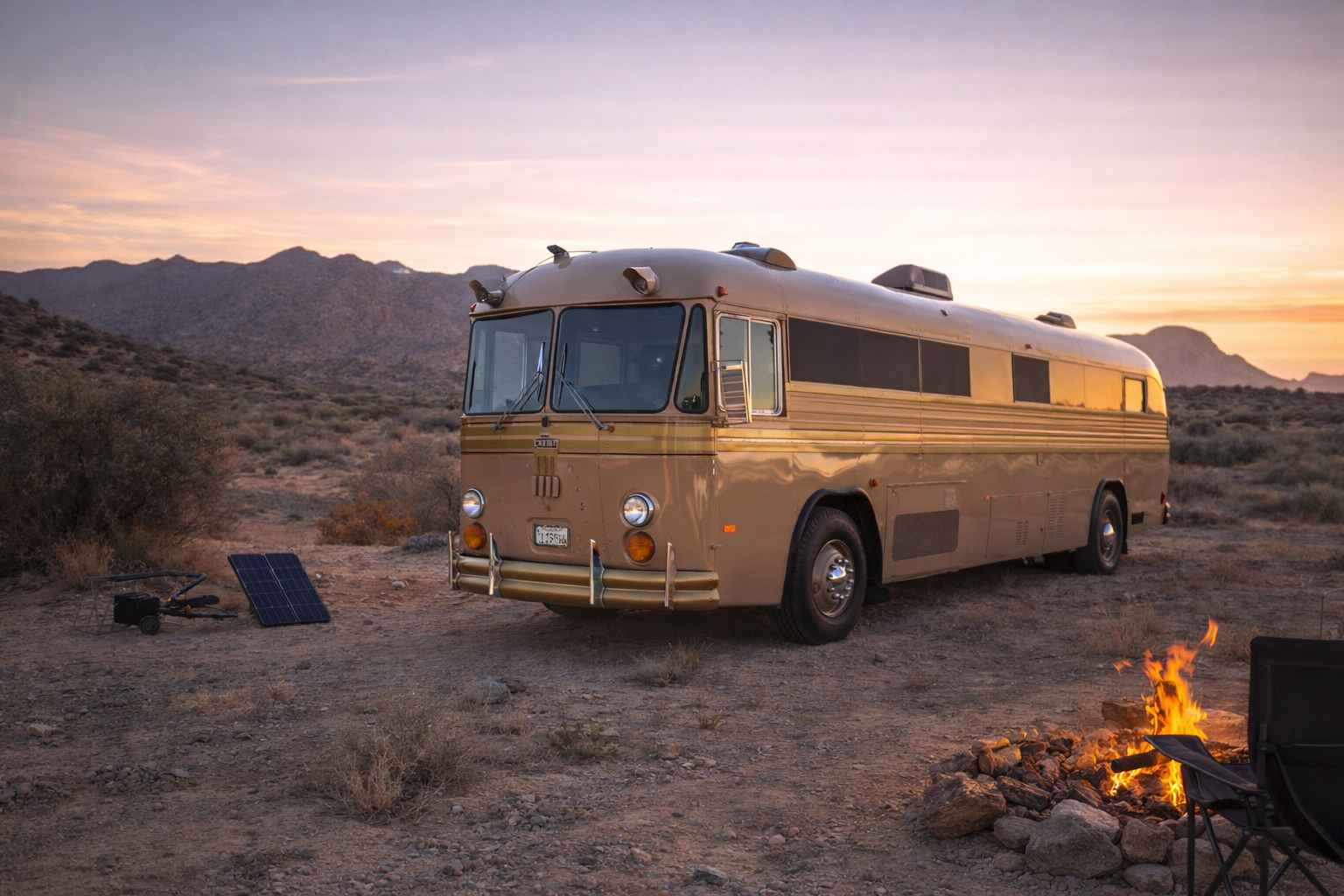
Boondocking, i.e., camping without hookups, is a popular option for many Nomads, who enjoy pure freedom. It means relying on your own water, power supply (generator or solar), and holding tanks for fresh, grey, and black water (for those who have flush toilets).
The alternative is campground living, where you’ll have an endless supply of water, 30 or 50-amp electrical hookups, and waste connections. Many also come with amenities like showers, gyms, and a sense of community if you are a social person. Some people need that. Others are content with no one else around, with the exception of maybe a pet to discuss world politics with.
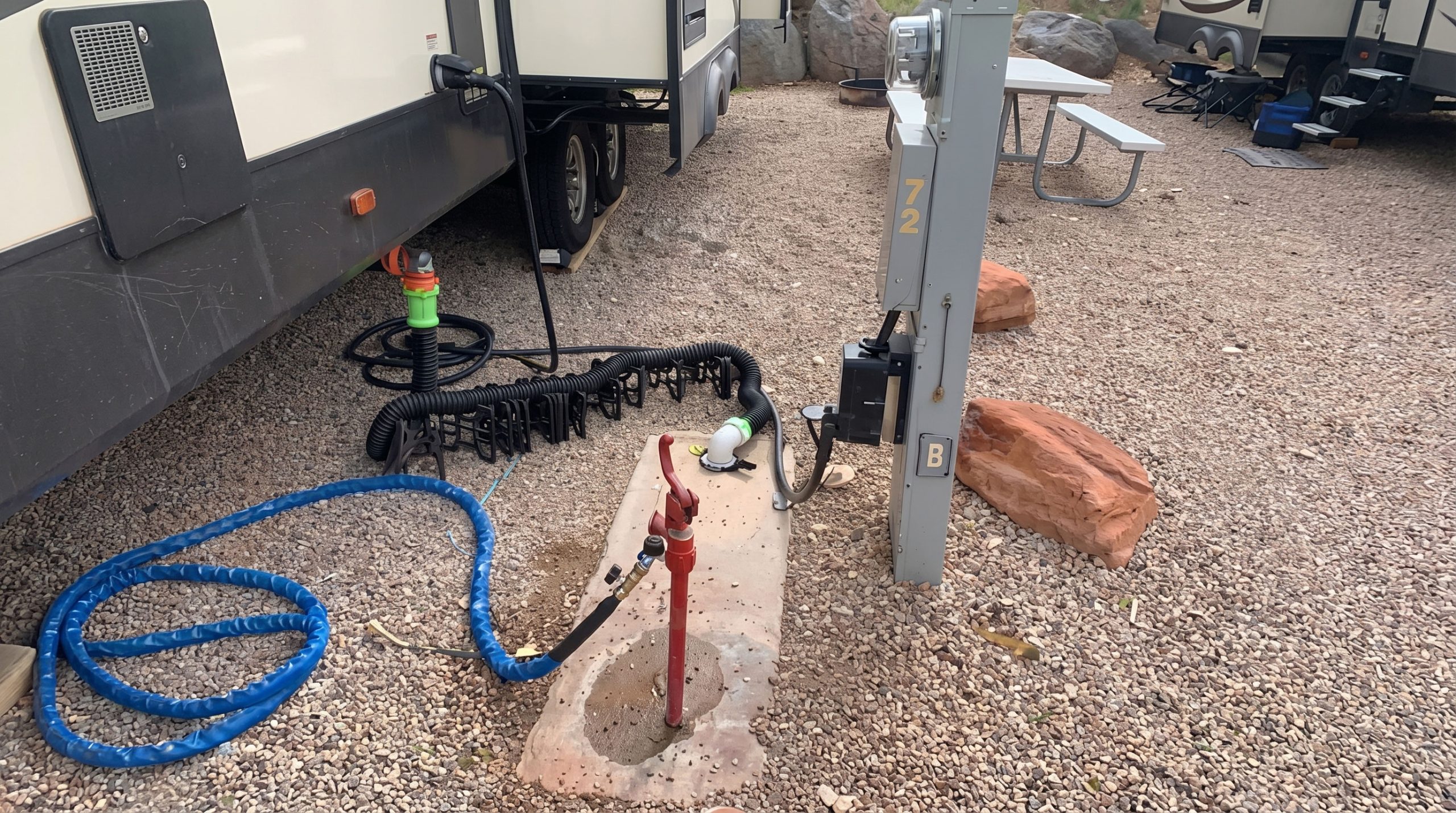
Campground Reality (and Misconceptions)
One thing worth mentioning, especially for RV conversion owners, is campground acceptance, especially for Skoolie and vintage bus owners. Most campgrounds will accept you, but occasionally you’ll run into restrictions, especially in the more expensive campgrounds and especially in the “resorts”, often framed as “10-year rules.” Officially, these are about the safety and condition of DIY conversions. Unofficially, they’re about maintaining a certain aesthetic. If rough-looking rigs are parked in a campground, it may preclude the more expensive, bigger-spending clientele from staying there.
Ironically, many of these policies favor modern factory-built RVs, despite the fact that they typically consist of foam cores and thin wood paneling. However, they are built to RVIA (Recreational Vehicle Industry Standards). This ensures that plumbing and electrical components are built to code, making them safer than DIY conversions, which could be built by anyone, even those with little construction experience.
However, most factory-built RVs are nowhere near as robust as a commercial bus platform. That’s not a criticism so much as a reflection of design intent. Conventional RVs are built to be lightweight and cost-effective for occasional or weekend use, or for those who take one or two vacations each year, not for continuous duty, as is required of full-time travelers. Passenger buses are built to travel hundreds of thousands or millions of miles with proper maintenance. Passenger buses are revenue-generating, so maintenance cost is not as much of an issue.
It’s also worth touching on safety and structural integrity because these are rarely discussed honestly.
School buses, in particular, are designed around occupant protection. They use heavy-gauge steel roll-cage construction, reinforced roof structures, and are engineered to withstand rollovers and impacts, because they’re built to transport children safely. Tour buses take a slightly different approach, prioritizing ride quality and long-distance comfort, but they are still commercial-duty vehicles built to far higher structural standards than typical RVs.
By contrast, most conventional motorhomes rely on lightweight construction methods. That works well for reducing weight and improving fuel economy, but in any kind of mishap, whether it’s a low-speed impact or something more serious, they simply don’t offer the same level of structural integrity. When they are involved in an accident, it usually takes a front-end loader and a dump truck to pick up the pieces. It’s not something most people like to think about, but it’s part of the reality of choosing a safe platform, especially for those traveling as families.
That said, in practice, if your rig is presentable, most campgrounds will simply ask for a photo and let you in. In three years of full-time travel, I’ve never had a serious issue, but it’s something to be aware of. Skoolies tend to face the most scrutiny, followed by tour buses, while vans, if well kept, generally slip under the radar most of the time.
Publisher's Note: For more information, read Converted Buses and Skoolies Not Welcome.
Budget, Initial and Ongoing Expenses
Budget is the next major factor.
Right now, used tour buses represent an exceptional value. Fully converted units can be found for around $15,000, while seated coaches like an MCI MC-9 can be had for as little as $5,000 – $7,000. School buses are often even less expensive and are usually in good mechanical condition, if you buy them right out of service, as they must be properly maintained to transport school children. Tour buses do as well, again, if you buy them right out of service. Used motorhomes generally do not have to meet the same stringent DOT standards, so buying one requires a detailed inspection.
Once converted, Skoolies often try to command surprisingly high prices, sometimes approaching those of professionally built top-of-the-line Prevost conversions, despite widely varying build quality. Fortunately, it’s the market that drives prices, not only the effort, and that market appears to be cooling. Most conversions sell for significantly less than their advertised price.
But the purchase price is only part of the story. Operating costs also matter, and this is where many people underestimate the cost of ownership.
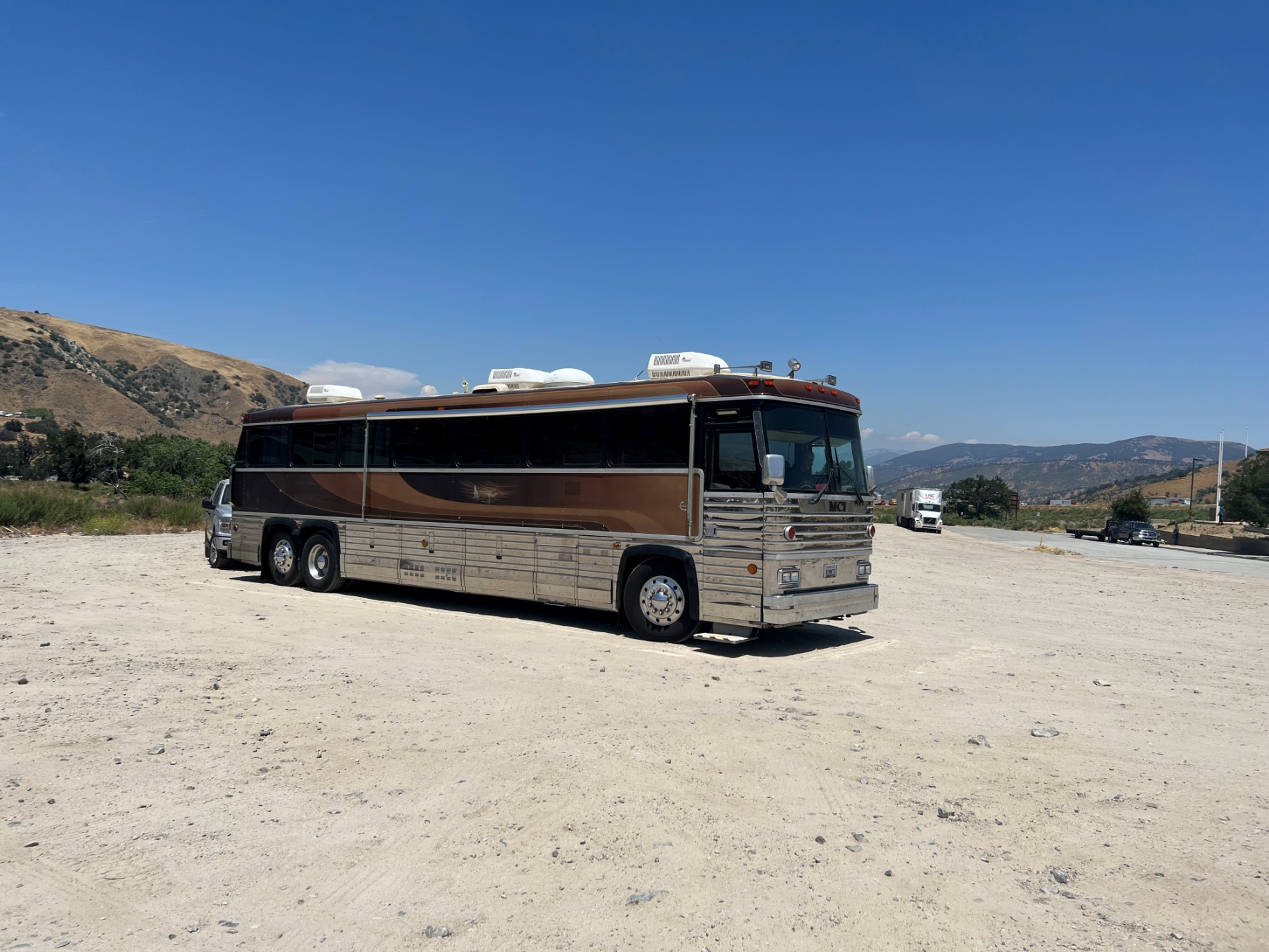
Take tires, for example. My MCI bus requires commercial truck tires, costing $700 – $1,200 each. On a multi-axle coach, that adds up quickly. While commercial grade tires are designed to run 100,000+ miles, most RVers will age them out long before wearing them out. UV exposure alone dictates replacement intervals, typically no more than seven years, often less if they are always parked outside.
There’s no negotiation here. This is safety-critical. A tire blowout can be deadly, especially if it is one of the steer tires, as it can cause you to lose control and veer off the road into oncoming traffic. Any tire blowout can cause thousands of dollars of damage and shut your bus down for several weeks while parts are sourced and repairs are made.
Publisher's Note: Watch the video here on The Critical Factor – How To Handle a Tire Blowout on a Bus.
Terrain and Capability
Where you go matters.
If you plan to boondock frequently, ground clearance becomes important. Skoolies tend to have an advantage, often with heavy-duty truck-type rugged leaf-spring setups. Vans, especially 4WD models, also perform well in more remote environments. However, these rigs, especially Skoolies, ride very rough, and your stuff may all end up on the floor if you venture very far off-road.
Tour buses, on the other hand, are designed for highways. They ride very smoothly and excel at long-distance travel, but are less suited to rough terrain. Most are seldom driven off blacktop, and ditches or steep ramps can cause them to bottom out easily. When hung up, a tow can get very expensive, very fast.
The other thing worth mentioning, especially if you’re a full-timer, is that a 40 or 45-ft-long tour bus or Skoolie will almost certainly require an auxiliary vehicle to be towed (often called a toad or dinghy) to run errands and go shopping. It is difficult to maneuver a 40-foot-long bus into many grocery store parking lots, and parking can be almost impossible on a busy shopping day. Then, once parked, there are those who will try to block you in just to be annoying.
And yes, buses struggle in the mountains. Vintage buses have an older power baseline than modern trucks. You’ll climb slower, and you’ll occasionally deal with impatient drivers, honking their horns behind you and trying to pass. It comes with the territory. Buses can also present difficulties when traveling on narrow winding roads and maneuvering in smaller towns and cities while scouting for water fill and dump stations. They must also be driven with care when descending hills to prevent brake overheating. These are heavy vehicles and must be driven with care.
There are workarounds for finding fuel, water, and other supplies, such as driving farther to the nearest truck stop that offers those facilities or carrying a fillable water bladder in your towed vehicle. Also, keep in mind that truck stops generally charge more for fuel unless you have a fleet fuel card, as many truck operators have. But truck stops have more room to maneuver a big rig than a regular gas station so it is easier to get in and out.
Lifestyle Fit


Fancy Office Setup
The Inside
This is where things get personal. If you have a family, van life may not be for you. There is only so much room inside a van, now matter how you convert it. But for one or two people, a van may work well. For more than two people, a Skoolie or tour bus may suit your lifestyle better.
Each platform comes with a lifestyle, and even a “social scene.”
Van life tends to attract more mobile, outdoors-focused individuals, people chasing climate, altitude, and adventure. They also usually enjoy over twice the fuel mileage of a bus, thereby enabling them to travel more for less money. Skoolies often lean toward creative, DIY-oriented communities. Bus conversions tend to appeal to those who prioritize comfort and long-term livability and are better suited to full-timers due to the additional space. Skoolies seldom have luggage compartments underneath, but most tour buses do. They are much better suited for fill-timing due to the additional storage.
Your hobbies matter. If you’re into climbing or exploring remote terrain, a van might make more sense. It allows you to get into the areas where that activity takes place. If you’re working remotely, writing, or cooking regularly, as I do, you’ll likely appreciate the space of a bus or Skoolie. But don’t forget, if you have a larger bus, you will probably also have a toad to scoot around in, so perhaps this is not an issue. An SUV will make those prime climbing spots more accessible.
Power, Climate, and Comfort
Air conditioning alone can dictate your entire setup.
You can live without air conditioning; people have done it for years, but for maximum comfort, it means chasing moderate climates year-round. Many do exactly that. Check out how to enjoy 70-degree weather year-round HERE.
For most, though, A/C is non-negotiable. Roof units can draw up to 2,000 watts of power each, while mini-splits are more efficient. A 35-foot coach might run two units; larger rigs, three; a 40 or 45-foot-long rig with slides may require four units. And even with three or four roof units, it may not be possible to cool the inside of a coach down below 90 degrees on a hot summer day in the south in the summer when temperatures reach the triple-digits.
The power demand directly affects your generator and solar strategy; both systems need to work together. You CAN live in a hot RV, but trying to do remote work or conduct Zoom calls while sweating can get uncomfortable fast. You will be much more productive in a comfortable environment.
Stealth vs Scenic Living
Another factor is how visible you want to be.
Stealth camping, staying unnoticed in urban environments, is much easier in a van. You can get away parked in the corner of a Walmart or Home Depot for hours unnoticed, and can get further off the road for even more privacy. Tour buses and Skoolies, by contrast, attract attention wherever they go and it is more challenging getting far off the road for maximum privacy.
On the flip side, all three can access scenic locations, though higher-clearance vehicles have the advantage off-road.
Personally? I camp everywhere in my bus, from truck stops along my route to remote spots in Monument Valley. It’s all part of the experience. On top of that, I have a toad to take me places the bus won’t go.
Comfort and Driving Experience
Comfort isn’t just about living space; it’s also about driving.
Tour buses excel here by far. They’re designed to drive long distances in comfort, with excellent ride quality and sound insulation. Even my 1964 MCI, with its old two-stroke diesel, is remarkably smooth and quiet. Of course, it is a diesel pusher, meaning the engine and the noise are in the rear of the bus, way behind the driver and front passenger, so we can easily carry on a conversation while traveling at highway speeds.
That said, larger vehicles require driving confidence, especially in tight environments. Psychologically, driving a longer, taller vehicle can take some getting used to. Especially when driving or backing into tight spaces. On the highway, that is usually not an issue. But many tour buses, which tend to have higher rooflines, can be challenging to drive down narrow streets and enter forest service campgrounds due to low-hanging branches.
The Reality Check
Once you’ve chosen a platform, you need to assess it honestly. Can you afford to maintain it?
- An oil change on a bus can take 9 gallons, not a few quarts like a van.
- How much does a transmission or engine rebuild cost?
- Are parts readily available for an older bus or van?
- Is support available for the drivetrain?
- How handy are you, really?
This last one matters more than most people think. Buses and Skoolies reward mechanical competence. If you’re not inclined that way, it will significantly influence your experience. If you have to hire mechanics to do all the work on your bus, with hourly labor rates now over $150 per hour most places, and you probably will not be able to live in your bus while it is being worked on, thereby forcing you to get a motel room for the duration, another potential cost factor. Also, places that work on large buses are not as popular as garages that can work on vans. Buses require heavy equipment to move them and to work on them and require larger garages which tend to have higher overhead costs, thereby they are fewer and farther between.
There are also practical considerations:
- Larger rigs can be harder to squeeze into places to fill with water or dump in certain areas, but there are always workarounds as noted above.
- Older buses require patience, especially in mountainous terrain. They can be slow when crawling up hills.
- They become part of your identity. Driving one is a bit like owning a classic car.
Final Thoughts

Typical Stick-N-Staple RV.

Typical Tour Bus Construction.

Typical School Bus Construction.
In Summary
Every type of vehicle is optimized for something.
- Vans offer mobility and stealth.
- Skoolies offer ruggedness, flexibility, and character.
- Tour buses offer durability and comfort.
As for conventional RVs, the typical factory-built “sticks-and-staples” construction is designed primarily for occasional use. They prioritize cost and weight over long-term durability. That’s fine for weekend trips, but under full-time use, the compromises become more apparent as things start falling apart after a few thousand miles.
By contrast, buses and Skoolies were built for continuous duty. School buses can run hundreds of thousands of miles with proper maintenance. Over-the-road tour buses can run millions of miles with proper maintenance. That difference matters in the long run, and when considering the resale value.
As a review, it’s worth discussing safety and structural integrity, as these are rarely discussed honestly.
School buses, in particular, are designed with occupant protection in mind. They use heavy-gauge steel construction, reinforced roof structures, and are engineered to withstand rollovers and impacts, because they’re built to transport children safely.
Tour buses take a slightly different approach, prioritizing ride quality and passenger comfort over long distances, but they are still fundamentally commercial-duty vehicles built to far higher structural standards and rollover protection than typical motorhomes.
By contrast, most conventional motorhomes are built with lightweight materials to reduce cost and weight. That makes them efficient for occasional use, but in any kind of mishap, whether it’s a low-speed impact or something more serious, they simply don’t offer the same level of structural integrity or passenger protection.
It’s not something most people like to think about, but it’s part of the reality of choosing a platform to convert.
One Final Piece of Advice
Whatever you choose, you have to love it.
Because it won’t just be your vehicle. It’ll be your home, your project, and your companion on the road.
And if you don’t love it, it will wear you down.
In the end, the key is simple: understand what the vehicle was designed to do, and be honest about whether that aligns with how you intend to use it.
Because on the road, reality has a way of making those differences very clear. For example, getting a van stuck in the sand or mud while five miles off the road is relatively easy to get out, whereas extracting a 40’ bus out of the same predicament can cost thousands of dollars.
Only you know how you want to live and travel and what your driving comfort level is. Only you can choose the proper vehicle for your own lifestyle. Plan how you want to live and the planned and possible changes in your life over the next several years before choosing any vehicle.
Rupal Paul, who often goes by Marcus online, was born and raised in London, United Kingdom. A qualified Mechanical Engineer involved in many engine and vehicle designs, including Jaguars, Aston Martin, Acura, Honda, and heavy-duty truck engines. He currently works designing and developing racing engines. Marcus also writes Sci-fi Novels in his free time.
He emigrated to the USA about fifteen years ago. He’s always been strongly drawn to the nomadic lifestyle in the States. He travels alone across the USA in his 1964 MCI MC-5 tour bus, “The Dreadnought.” Marcus owns several vehicles, some of which he was involved in designing, and several projects, from Jaguars to old classic Mopar muscle cars.
His current nomad lifestyle involves many stationary periods. He will transition to a more mobile lifestyle in the bus in the future. It’s been said that a nomad doesn’t feel stable when stationary but feels stable when experiencing velocity. This quote encapsulates Marcus to a Tee.
Marcus acquired Dreadnought, a 1964 MCI MC-5, in 2012 when it was already converted. He finished tailoring it to his specifications and style in 2022 using a combination of his own design work and work from various suppliers. It hasn’t been easy, but it’s mostly done now.
You can follow Marcus and his Dreadnought MC-5 on YouTube.
You can also email Marcus at DreadnoughtMC5@gmail.com
to open the company's website.