


No products in the cart.

Phil and Ginni Lyons
March 28, 2025
74 views
Can I Flush my Radiator with Vinegar?
I’ve been struggling with heat in my engine more and more as my radiators continue to deteriorate. I’ve heard of a few people using vinegar to flush their radiators. Will a flush using vinegar of the entire system help? My goal is to get a season or two more out of them. One method I heard about was filling it with about 20 gallons of vinegar, running it, and then letting it sit for a day. Next would be to drain it. After that, there would be lots of gunk. Repeat the process. Then neutralize and rinse a few times, and then fill with coolant. I figured I’d check my thermostats as well. Post by: neoneddy
Post by: oltrunt
It's just a personal opinion, but I'd say spend the $2,000 now on radiators rather than potentially spending $25,000 shortly down the road on a new engine. I could see flushing the engine after new radiators, but not before, especially as you seem to be having bouts of overheating. My advice assumes that you have the proper antifreeze, working thermostats, etc.
Post by: rancher
These are my thoughts also. If you have bad radiators, replace or repair them now before you have bigger problems later. I have flushed a radiator, but that was to get oil out of it after an oil cooler failed.
Post by: luvrbus
I agree; buy the new radiators now. At today's prices, you can spend $30,000 on an out-of-frame reconditioning on the 6V92TA.
Post by: Iceni John
Last year, my engine was totally rebuilt. I was surprised when we hot-tanked the block, just how much scale and gunk there was on the inside of the block and inside all the fluids' passageways. This scale is an insulator that reduces heat transfer from the engine to the coolant. Some years ago, I also completely rebuilt the entire cooling system to address some overheating issues. It helped somewhat, but not as much as last year's rebuild. I now have a cooler-running engine than ever before in the fifteen years I've had the bus.
Post by: luvrbus
I had an 8V92 in the shop, and somebody left a shop towel inside the cooling system. It destroyed the engine; it came apart in small pieces and stuck everywhere. I would want the block hot-tanked like John's.
Post by: buswarrior
Detroit used to have a two-part cleaner. One powder was the acid, the other the neutralizer. Wear eye protection and old clothes, as the powder mixes well with hot water. Collecting the acid drain-off and adding the neutralizer drain-off somewhat dampens the environmental issues.
Post by: dtcerrato
When we tried to remove the oil residue from the cooling system after a blower disintegration, some Bus Nuts suggested a mix of dishwashing powder Cascade diluted in hot water. We followed that suggestion, and it worked excellently the first time around.
Post by: luvrbus
Vinegar is good at removing rust, but it is very caustic. It takes a lot of flushing to remove vinegar from a system. I would not use it on a wet-liner 92 series engine myself. The liner seals on the 92 are a little iffy to begin with, and you really don't want to be changing those seals.
Post by: Jim Blackwood
A little correction is in order: vinegar is an acid. Acids are not very effective against oils, but caustics like lye can be effective, including sodium, oven cleaners, and some drain cleaners. The acid probably does work against the scale, but you might have to leave the vinegar in there for a long time. Some acids eat rust scale better than others. Check with a chemistry teacher for what acid and concentration would work the best and how long to leave it in at what temperature.
Then there are the gaskets. Prolonged exposure can compromise them. We've used this method on tractor engines. Once the scale is gone, more rust will form extremely fast without good rust protection.
Post by: neoneddy
Here is an update on the status of my radiators.
I ended up putting in 12-14 gallons of Vinegar. I cut off the heating system from this adventure. Then, I let it work for a day, running the engine a few times daily. Later, I took a sample, and it was very white. I figured the white color was a lot of the calcium and scale. How did that mess get in there? Who knows, maybe some idiot put 10 gallons of water into it on the side of the road in Wyoming one summer and forgot about that until November of that year.
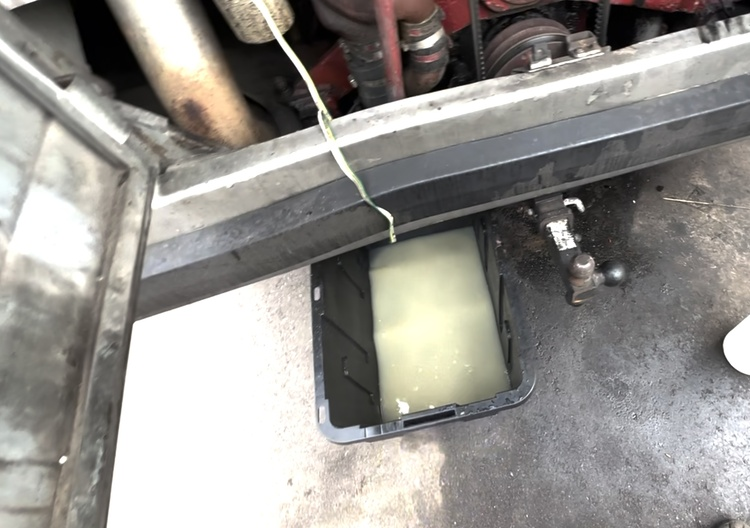
The next day, it all turned reddish brown. My friend who suggested this cleaning process said that his cooling system also experienced reddish-brown colorization.
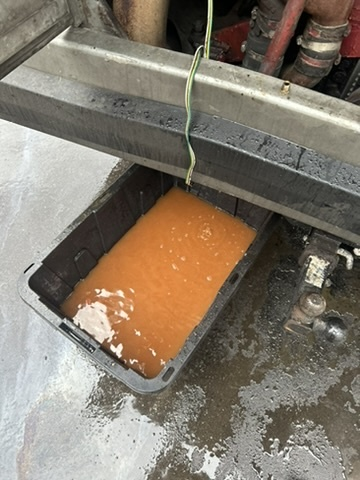
Reddish brown flush
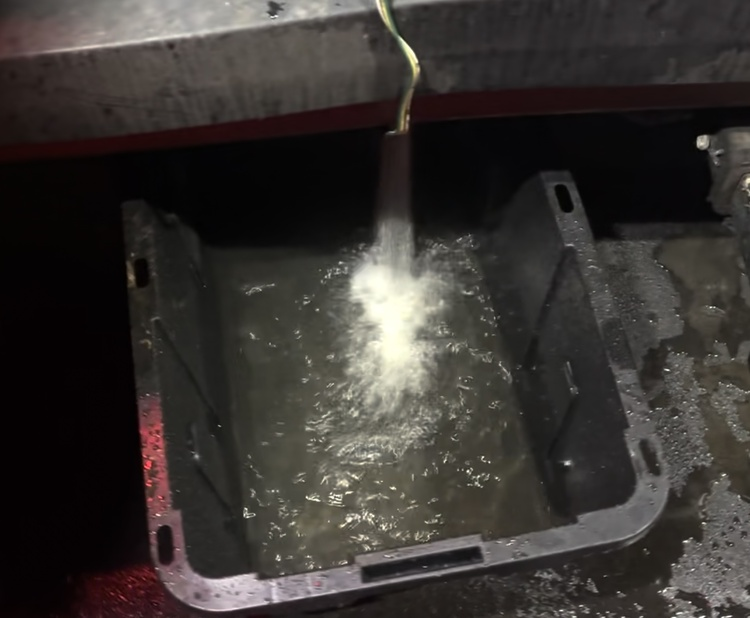
I let it sit another day. However, the weather was turning cold, so I had to start flushing, and flushing, and flushing. The rinsing required 12 flushes to get the water to run clear, clear enough anyway.
I hope to road-test it again sometime soon. The real test will be about a month from now, here in Texas. We usually get warm temperatures coming down to Corpus Christi from the Austin - San Antonio area, while pulling the van.
BUT WAIT... THERE'S MORE!!!
Click on the link below to read additional comments that may have been added after we published this article. There may be many more comments with even more information that may be useful to you and your bus.
Forum content extracted by Phil Lyons, our Chief Forum Moderator. To read the rest of this discussion in the Forum, click this link:
https://www.busconversionmagazine.com/forum/index.php?topic=37017
Discussions like this take place on a daily basis in the BCM Online Discussion Forum.
To read them go to:
https://www.busconversionmagazine.com/forum/index.php
Anyone can read the discussion board, but to get the most out of the Forum you need to join by clicking the “register” link above the login box in the upper left section of the Forum page.
Registration is free and once registered you will be able to view all the available discussion boards, view images, lookup and contact other members, reply to other members, share your own experiences for others to learn from, and most importantly, post your own questions.
See you on the Forum!
Article written by Phil and Ginni Lyons
Phil Lyons has been a Bus Nut and moderator of the BCM forum for many years. He and his wife Ginni live in the central highlands of Arizona. Phil’s day job is in IT Security and Ginni is a retired Registered Nurse.
They are the proud parents and grandparents of daughters, granddaughters, and two spoiled dogs.
Phil and Ginni are part of a bluegrass/gospel trio called Copper Mountain String Along, are members of Bethel Baptist Church in Prescott Valley, and volunteer and serve in various capacities in the church and the community.
RVing has been part of their lives for over 35 years, and they both hope to enjoy the bus lifestyle for many more years.
You can contact Phil via email at
Phil@BusConversionMagazine.com
To be the first to read all new articles and to read thousands of articles about conversions back to 1992, become a member of BCM.
Click HERE to become a Member now!Click on any image in this column
to open the company's website.
to open the company's website.