









No products in the cart.

Jerry Work
November 14, 2025
62 views
Battery Boot Camp
A watt is the unit of measure of how much work electricity can do for you. A Watt is generally calculated as Volts times Amps i.e. W=VA. Almost all electrical appliances are rated by the number of watts they are designed to consume.
Higher amps require the use of larger and more expensive wire. If more amps pass through the wire than the wire is designed to carry, it will overheat and can cause a fire. To protect the wire from overheating, a device called a fuse or circuit breaker is employed, which will shut off the flow of electrons if the amp capacity of the wire is exceeded.
If the voltage is doubled, then the amps required to deliver the same number of watts will be halved. Therefore, a 12V circuit will need approximately 10 times the number of amps to deliver a given number of watts as a 120V circuit would.
Electric motors are generally referred to as inductive loads because they require the production of a magnetic field to cause the shaft of the motor to turn. The amps needed to start the motor turning initially are often double or more than the amps required to keep the motor turning. If the motor is under load when first starting up, it will require even more amps on startup. A roof-mounted air conditioning unit on an RV can draw three times the amps at start-up than it requires while running.
Some appliances (like electric heaters, electric ovens, or electric stoves) utilize the heat generated by amps passing through a conductor to do the work. Those are called resistive loads. Some appliances (like microwave ovens and induction cooktops) use magnetic fields in a different way from electric motors, and they are also called inductive loads.
For more information on how to soften the startup amperage, read this article “How to get by on 30-Amps or Less”
Batteries are standalone devices that generate electricity through chemical reactions. There are many different kinds and capacities of batteries, each utilizing chemicals that are optimized for a specific use. At present, lithium iron phosphate (LiFePO4) chemistry (AKA LFP) is optimum for recreational vehicle house battery use and currently represents the safest LITHIUM battery chemistry available for RV use.
For more information, read “It is Now a Near No-Brainer to Add Lithium Batteries to Your RV”
LFP batteries differ significantly from lead-acid batteries, commonly used as engine starting batteries. Lead-acid batteries are optimized to deliver several hundred amps for a few seconds, which is required to spin over a cold engine. LFP batteries are optimized for providing a smaller number of amps over a relatively long period, which is necessary to power household electrical loads such as lights, fans, and pumps. The battery management system circuit board inside an LFP battery limits the amp output to approximately the amp-hour capacity of the battery, making it normally unsuited for engine starting tasks.
Because different battery chemistries operate so differently, never connect them directly to each other. Connect only batteries of the same chemistry and capacity. Furthermore, if connecting two or more LFP batteries, use only batteries that also use the same BMS (Battery Management System).
When connecting two batteries of the same chemistry and capacity in parallel (positive to positive and negative to negative), the voltage remains the same, while the combined capacity (amperage) doubles. When connecting two batteries of the same chemistry and capacity in series (positive to negative, and negative to positive), the voltage doubles while the capacity remains the same. It is common to connect two 12V batteries in series for buses with a 24V system.
A converter/charger is a device that takes 120VAC as input and converts it to 12VDC to 15VDC as output. These are often used to supply the nominal 12VDC required by the “house circuits” in an RV (powering things like 12VDC lights and appliances). They are also often used to recharge various kinds of batteries by selecting the chemistry of the battery you want to recharge. If the converter/charger has no way to change settings for different battery chemistries, it is designed for use only with batteries of the indicated chemistry. Each different battery chemistry requires a specific charge profile in terms of volts and amps supplied to the battery over time.
An inverter does just the opposite. It takes a nominal 12V DC input and produces a 120V AC output. Most of these now produce an alternating current similar to what you find at a standard household outlet (called a sine wave output). Cheaper and less desirable inverter/charger units will produce a modified sine wave output (often also referred to as a square wave output), which can be damaging to some 120VAC appliances. Use only pure sine wave output inverter/chargers.
These inverter/chargers are generally rated for the total number of watts they are designed to produce in continuous use. Match the wattage of the inverter/chargers to the sum of the watts consumed by all the appliances you want to power off that inverter/charger at the same time. Note that converting 120VDC to 12VAC is not an overly efficient process, so plan on being able to power only about 80% of the rated capacity. Note also that the startup amp draw may be two or three times the rated value of the appliance while running, so take this into account when sizing an inverter/charger. The battery charging side of an inverter/charger works in much the same way as in a converter/charger.
A battery-to-battery charger is a device that uses the charge current present at one battery being recharged as input and converts it to the charge current profile required by a second battery with a different battery chemistry. It also prevents amps from flowing backward from the second battery to the first, thereby isolating the two. This is particularly important when you want to charge a lithium-ion battery from a charge source designed for lead-acid batteries.
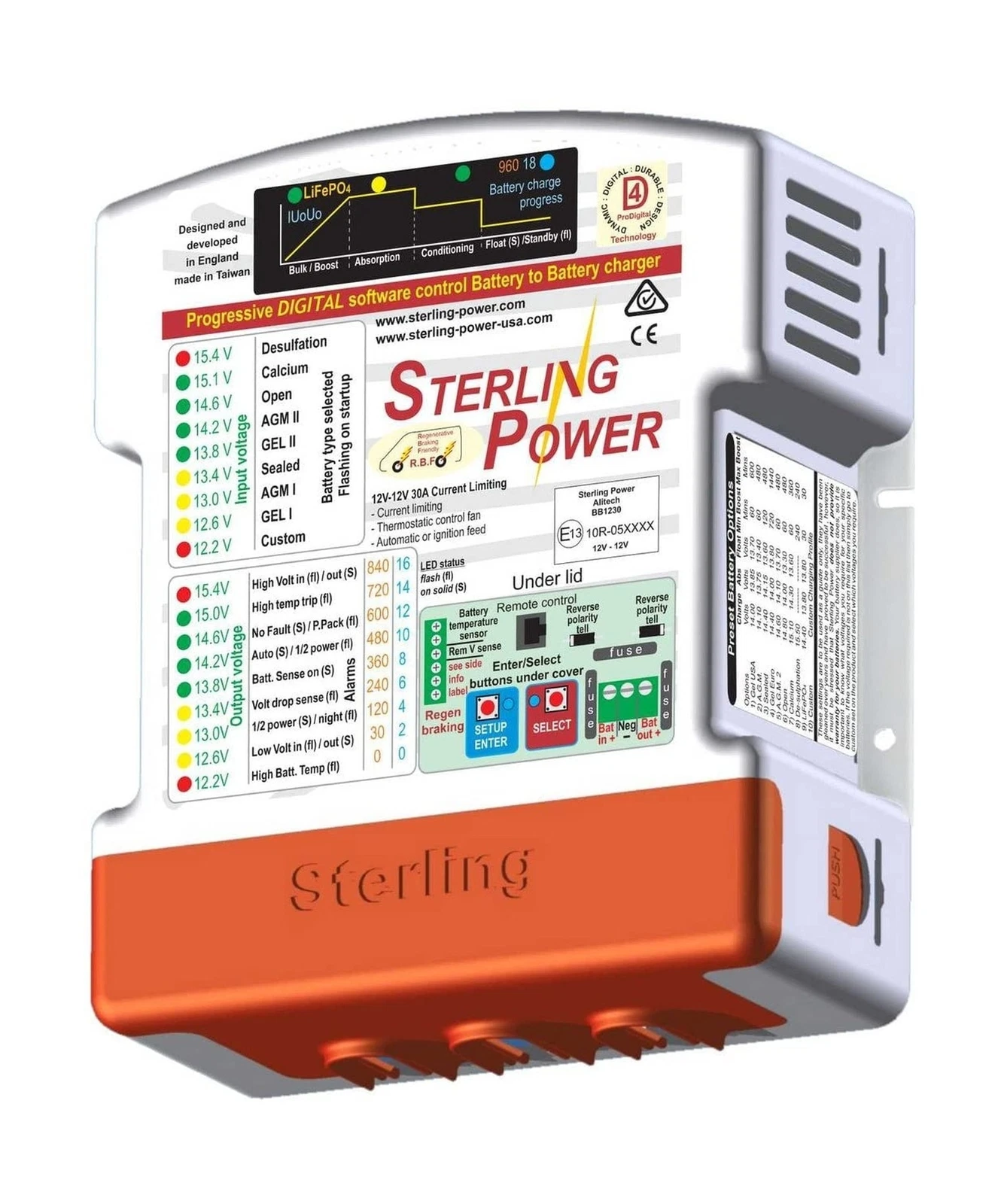
An example is when you want to recharge a Lithium house battery from an engine-driven alternator designed to recharge the lead-acid engine starting battery. The B-to-B charger will take the charge current from the engine starting battery, which is being recharged via the alternator, and modify it to the charge profile required by the LFP house battery. It will also prevent the two different battery chemistries from being connected. It will also limit the amps supplied by the engine-driven alternator to the rating of the B-to-B charger (usually 30 to 60 amps). When sizing a B-to-B charger, select one that has about 60% of the rated capacity of the alternator to keep the alternator from overheating.
A solar battery charger takes as input the constantly varying volts and amps from a solar panel. It converts them into the volts and amps required to recharge a battery of a given battery chemistry. Solar charge controllers come in two types: a less efficient Pulse Width Modulation (PWM) unit and a more efficient Multi-Point Power Tracking (MPPT) unit. They are rated by both the number of amps and the number of volts they can accept as input. Do not exceed either. Size them by the ratings on the solar panels you intend to use as input.
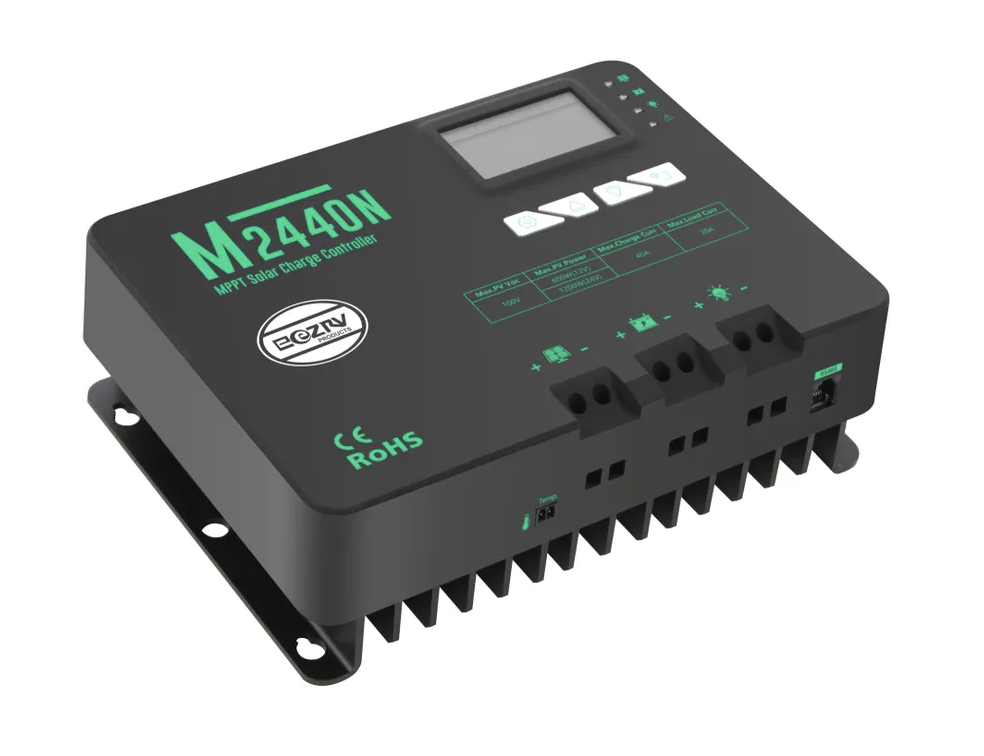
MPPT Solar Charge Controller from EEZ RV Products
You can use multiple types and sizes of battery chargers on a single battery. So, it is fine to connect one or more B-to-B chargers, one or more solar chargers, one or more converter/chargers and one or more inverter/chargers to the same battery so long as each unit is capable of outputting the charge profile required by that battery chemistry and so long as the total charge amps do not exceed the rated max charge amps of that battery.
Always use a current-limiting fuse or circuit breaker to protect the wire runs in your RV project, especially on the high-amp carrying wires attached to batteries.
Batteries suitable for RV house battery use are typically rated in amp-hours of capacity. That is the total number of amps that the battery can supply over time before becoming discharged. For example, a 100 amp-hour battery can deliver 100 amps for one hour, or 20 amps for 5 hours, or 10 amps for 10 hours, or 1 amp for 100 hours.
Depending on the nominal voltage of that battery, you can also easily calculate the number of watt-hours of capacity for that battery. To calculate how that capacity translates into usable work in your RV, add up the watt draw per hour of all the appliances, lights, pumps, and fans you expect to use, without having to recharge the batteries. For example, if you plan to run an 800-watt microwave for 15 minutes, it will consume about 200 watt-hours of battery capacity, irrespective of the type of battery you are using.
If you are using a 100 amp-hour LFP battery with a nominal voltage of 13.6 volts (fully charged), it will produce about 1300-1400 watt-hours of capacity. Running the 800-watt microwave through an inverter for 15 minutes will consume approximately 15% of the battery's capacity. Since the process of generating 120VAC from 13.6VDC is not 100% efficient, the consumption will be approximately 20% of the battery capacity. A typical flat-panel TV will consume around 40 to 60 watts per hour. An LED light somewhere around 0.1 to 1.0 watts per hour.
You can safely discharge today's LiFePO4 batteries down to zero in everyday use. Lead-acid batteries should not be discharged below 50% of their capacity without damaging the battery and reducing its lifespan.
Think of an LFP battery as a bucket of amps. To recharge one, simply put back as many amps as you took out. Most LFP batteries can be recharged at a rate of 0.5 to 2.0 times their rated capacity. The maximum discharge rate and maximum recharge rate are standard specifications for a battery. They are determined by the capacity of the battery management system built into every LFP battery.
A battery monitor is a device that measures the total amps going into or out of a battery. A battery monitor is composed of a precision resistor (called a shunt) attached between the ground side of the battery and all loads served by that battery, as well as some electronics that use readings from that shunt to calculate the amp flow in and out. Most battery monitors also include a display to show the total amps in and out, along with several other values that can be calculated from that information.
Wire size and type are two of the most important decisions you will need to make. NEVER use CCA (copper-coated aluminum) wire in an RV. Yes, it is much cheaper and readily available on sites like Amazon, but it has all the corrosion problems for which aluminum wire is justly panned. Always use multi-strand, tinned copper, marine-grade wire if possible. It has higher temperature insulation than auto-grade wire and can carry more amps for longer distances.
Use auto-grade multi-strand copper wire if marine-grade is too expensive for you. Use solid copper Romex wire in an RV only for AC runs and ensure it is well-supported to prevent the wire from breaking from constant vibration. Never use wire nuts in an RV, as they can fail unexpectedly and cause high-resistance joints that degrade system performance.
Use only professional-grade terminal crimpers when putting terminal ends on wire. Only pro-grade crimpers will make a proper gas-tight connection. Read "Tools for Cutting and Crimping Ends on Large Electrical Cable" for more information. Inexpensive Chinese stake-style or hydraulic-style crimpers may create a joint that appears satisfactory, but it will not be gas-tight. It will eventually corrode, resulting in high resistance and degraded overall system performance and reliability. You won’t know why your system no longer works as well as it did new, but if you used cheap crimpers, that will be the reason most of the time. Soldered wire joints in an RV can result in vibration fatigue or even wire fracturing at the end of the soldered joint; therefore, solder joints are never recommended in any vehicle.
Article written by Jerry Work
Jerry Work spent his professional career in technology management, first as the founder and CEO of two moderate-sized computer software companies and then as the Associate Laboratory Director for the Pacific Northwest National Laboratory (PNNL), one of the DOE multi-program laboratories. At PNNL, in addition to overall Laboratory management, he oversaw the laboratory’s work in the energy, transportation, medical and information technologies.
After retirement, he and his wife Sharon purchased a Beaver Patriot motorhome and began a cold turkey four years of full-timing which they enjoyed greatly. They then purchased a 1907 former Masonic Temple in rural Southern Oregon, restored the building and remodeled it into his studio and gallery on the first floor and living quarters on the second floor. There he designs and handcrafts fine furniture. He is well known for his many articles and tutorials about how to get the most from Festool and other-high end woodworking products.
They purchased the first of what became two fully restored GMC motorhomes, those iconic and swoopy front-wheel drive units from the 1970’s. They found the second of their two GMC’s in an air-conditioned building in Naples, FL, with just 11,000 miles on the clock following a ground-up restoration in 1984. Both of those motorhomes found their way from Mexico to Alaska and from the West to the East coast. He wrote extensively about his experiences with GMC’s and gave many a presentation at GMC club events over the years.
A few years ago they decided to go back out on the road again for longer periods of time than they could support in the GMC motorhomes so purchased a low mileage 1997 40 foot Country Coach Prevost bus conversion which is now home for more than six months out of the year. Visitors always welcome no matter where in their travels is their motto.
You can reach Jerry Work by email at:
GLwork@mac.com
To be the first to read all new articles and to read thousands of articles about conversions back to 1992, become a member of BCM.
Click HERE to become a Member now!Click on any image in this column
to open the company's website.
to open the company's website.
