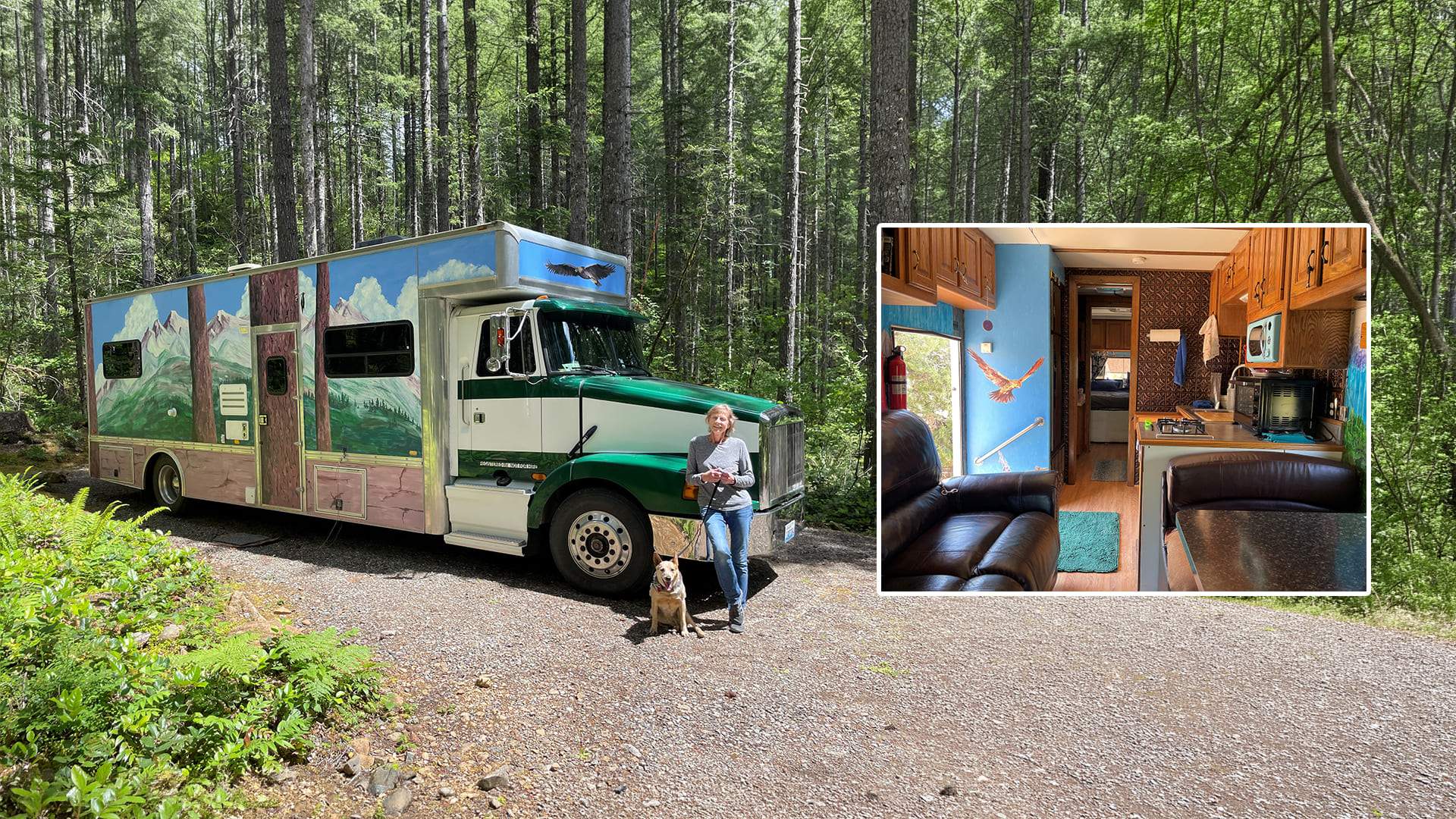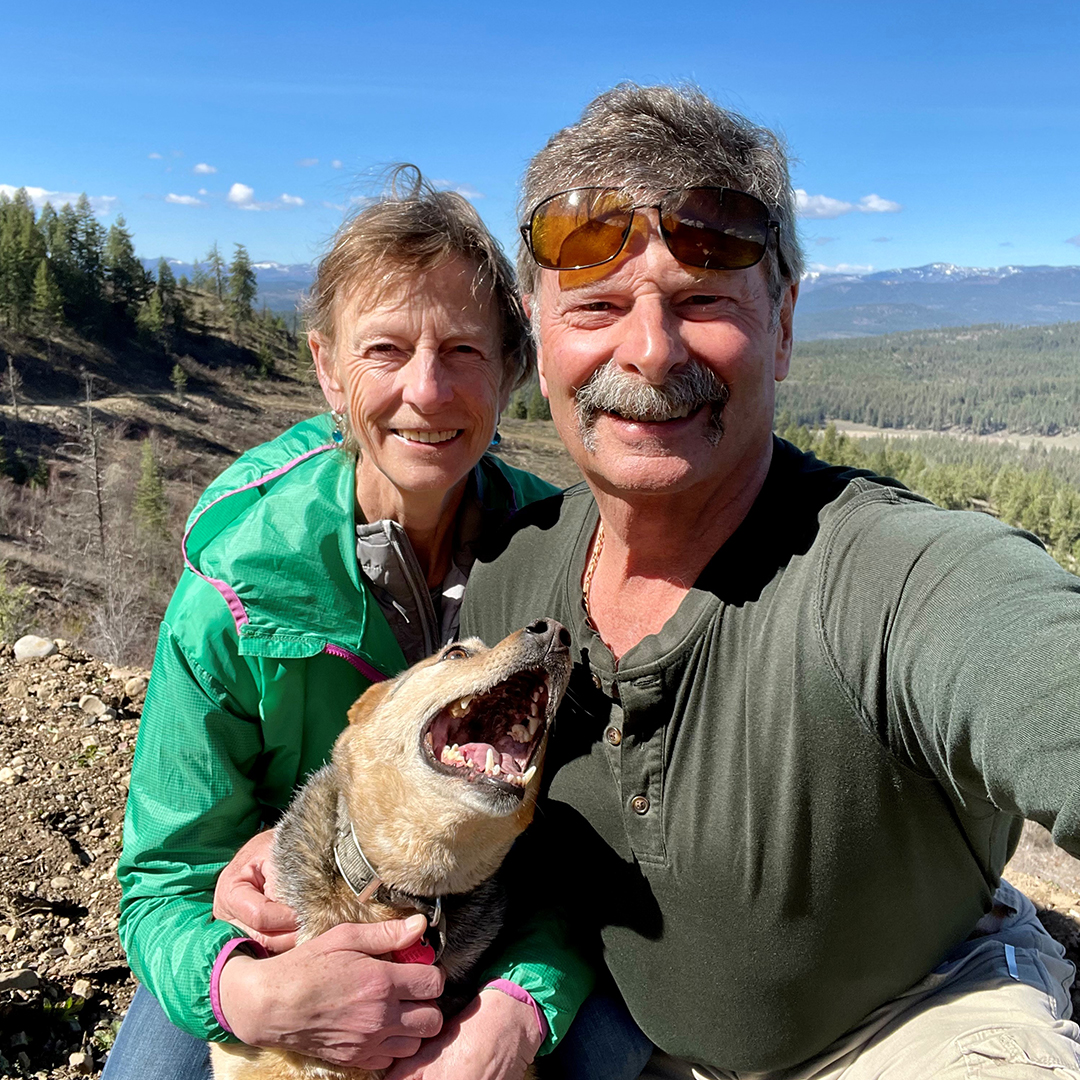
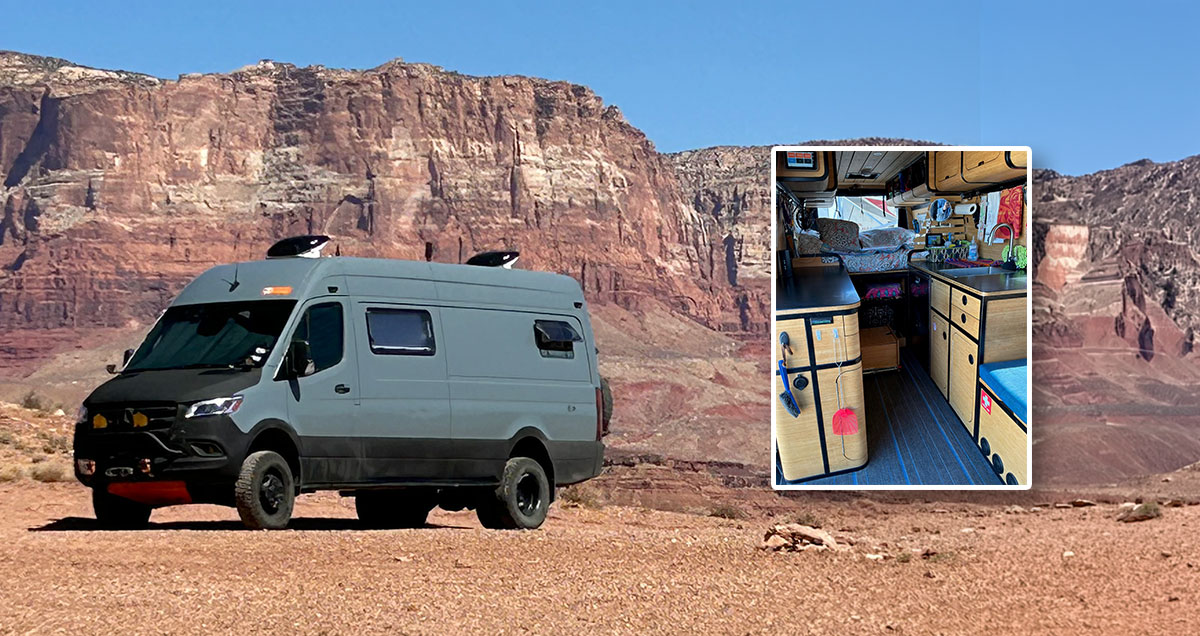
Elvie – Our 4x4 Dually Sprinter Van
I saw a Sprinter adventure van for the first time at OuterBike in Moab, and immediately recognized it as the ideal alternative to living out of a Dodge minivan. I retired as an IT exec at an investment firm at 56 and had conjured up the crazy idea that I could ride all the epic mountain-biking trails in the West in a single summer. A foolish notion, I know, but it did lead me to Moab, and my first encounter with a Sprinter van.
Connie and I had met prior to my trip, and upon my return to Virginia, she joined me from her home in New Jersey. The next day, we purchased a 2012 two-wheel drive 144” Sprinter 2500 van. I built it out (I am a former boatbuilder from before my IT days, so vans were easy) as a mobile mountain bike garage with sleeping quarters, and it served this purpose admirably.

We traveled with this setup part-time for a couple of years before deciding to go full-time. To this end, on a single day in January, we got married, listed my condo for sale, and made a down payment on a 2015 two-wheel drive 170” Sprinter 3500 Super Single EB from Sportsmobile in Indiana. Two months later, we hit the road. The 144” wheel base van was a bit tight for full-timing, so we were pleased to move into the larger van, once it was finally completed, custom built for us, nine months later.

Over several years, we crossed the country multiple times in our second, larger van, visiting national parks and mountain-biking wherever there were trails to ride. As much as we enjoyed that van, we really wanted four-wheel drive to go deeper into the wilderness. So, we ordered our third van, a 2018 4x4 170” Sprinter 3500 EB from Sportsmobile in Austin, TX.
This van had dual rear wheels. Duals were not so much a choice. We needed a model 3500 for its carrying capacity, and the only option for a 4x4 van this size and weight was a dual-rear-wheel model.
Duals have several drawbacks off-road, chief among them being the tendency to wedge fist-sized rocks between the wheels. This will quickly destroy the tires, and they are a bit of a pain to remove. This has happened to us on three occasions over the eight years we’ve been rocking duals (please pardon the pun). On the plus side, duals have much better floatation in the sand, and given that we spend a lot of time in sand, this works out for us.
In 2019, we were traveling down the Baja Peninsula with the Escapees Mexican Connection group (which you can read about in Traveling Around Mexico by Gary Hatt), just before our new 4x4 van was scheduled to come off the line. While exploring dirt back roads, we ended up drowning the 2015 van in deep water due to an obviously faulty but nonetheless logical assumption. The water reached the van's electrical system, and that was it.

The locals were a great help, but it took several tries before they could extract us. The pool we had dropped into had a hidden, deep hole in the center, and when we dropped into it, we buried the bow in the mud. With just two-wheel drive, we were well and truly stuck. Eventually, they rounded up enough horsepower and traction to pull us free, but by then, we had been stuck for over three hours, muddy water had infiltrated all the wrong places, and the engine eventually died. We were towed back to the zoo by their farm tractor, where we were staying.
We bummed a ride from Guadalupe Valley, Mexico, to Otay Mesa, south of San Diego, walked across the border, rented a car, and drove to Austin, Texas, to the Sportsmobile facility the evening before our new van was scheduled to be finished. We completed the necessary paperwork to take delivery and headed directly back to Mexico to join our friends and complete our trip. The old van was totaled, and insurance did not fully cover the loss, but we were able to absorb the financial hit and keep rolling. That was the end of Van #2.

We continued to travel extensively in the third van, including several more trips to Mexico. The reason behind upgrading to a 4x4 rig was to get back into the boonies to explore and camp off the beaten path. Despite their size and weight, Sprinters are surprisingly capable off-road, and we made extensive use of this ability.
The extended body, however, with additional length behind the rear wheels, proved rather limiting when going through washes, as we would drag our derrière too frequently. Consequently, we decided to order a fourth van with the standard body length, hoping this would alleviate our departure-angle problem. Other than the shorter body, it was the same spec as the previous one. With the new van having 16” less rear overhang than the old van, it did somewhat remedy this situation …
We first saw a ZENVANZ (RIP, they closed about a year after delivering our van) vehicle at the Overland Expo in Flagstaff and liked its construction technique (a welded aluminum framework with bamboo panels) and its high build quality.


We have not been disappointed - the quality of the materials and workmanship that went into our build is exceptional. The principals at ZENVANZ also had a nautical background, and they applied this experience to their builds. To paraphrase Psalms 107, those who go down to the sea in ships know that nothing takes a beating like a boat, and an off-road van does not lag far behind.
We worked with ZENVANZ to develop a design to our satisfaction (by this time, we knew what we wanted/needed). We have friends in Portland, Oregon, who were willing to host us for necessary visits to the shop, so we were able to get to know the folks who would be building our rig and to work out our specifications face-to-face. We were also able to visit from time to time to work through any issues that arose and to monitor the build's progress. Having been involved in a number of one-off builds in the marine industry, I was expecting a fraught process, but it went very smoothly from start to finish - kudos to the people at ZENVANZ.
Once we had worked out our general requirements and signed the contract, we hit the road again while they started the build. With the help of the Internet, we collaborated on the design process in detail, exchanging emails from a variety of backwoods locations we were enjoying. It took a lot of back-and-forth over the internet to iron out all the particulars, but we eventually nailed it down. The design process had been long, and perhaps even a bit tedious at times, but the result was a build that went very smoothly, and a vehicle that we are absolutely happy with.
Vans like we wanted, a 2022 4x4 170” 3500, were hard to find, and waiting for a special order to be delivered was looking like a many-month-long process, so we resigned ourselves to the wait. Fortunately, the folks at ZENVANZ were able to locate a van on the West Coast that had been ordered for a project that had fallen through.
It was not exactly the van we had specified, but it was close enough. The main feature it lacked was variable engine idle control, but we were able to add that function later by installing an IOPedal throttle control module. IOPedal lets us set our RPMs to any speed we like, helping the alternator generate the amperage we need to charge our batteries quickly. We are not a fan of idling the engine to charge the batteries, but in the clouds and snow of a NW winter, it’s sometimes necessary sans a generator.

In early Nov 2022, we took possession of Elvie, our “Last Van” (LV), and drove directly to Agile Offroad in Santee, CA, for significant off-road mods (see specs below). From the factory, the 4x4 vans have approximately 4” of additional ride height. The beefy suspension upgrades done by Agile Offroad added an additional 2”, and also eliminated the squatting problem typical of a loaded stock van.
One of the most significant mods was replacing the OEM transfer case with an Atlas heavy-duty transfer case. This was the fifth of the first six Sprinter transfer cases produced. Unlike the OEM transfer case, the Atlas is 100% gear driven, rather than chain-driven. Additionally, it has a 3:1 reduction in low range, compared to 1.4:1 for the OEM unit. This allows us to very slowly crawl up and down the steep, rough grades we sometimes encounter while traveling off-road.

Our intent with this van was to create a comfortable, capable overland rig/home that would take us anywhere we want to go. The Sprinter van drives more like a car than a truck (despite weighing in at slightly over 11,000 pounds), an important feature for any vehicle that is not a dedicated off-roader. It has ample storage space, plenty of room to move about, and several seating positions for a little variety.
From the factory, Sprinter 4x4s were intended to provide capable delivery vehicles in snowy climes, but they don’t really have the chops for serious off-roading. Fortunately, there are a number of outfitters, such as Agile Offroad, who endeavor to address this deficiency. With the proper mods (and, let’s be honest, a pile of cash), the Sprinter becomes a beast. Given its size and weight, I would hesitate to roll the Rubicon Trail, and would think twice about Mengel Pass in Death Valley, but other classic trails such as the Mojave Road, the Rimrocker Trail, and El Camino del Diablo are well within its ability.


While we have driven these trails and other lesser-known but equally challenging tracks, their main utility is that they allow us to get away from the highway, into the backcountry, and out of sight and sound of other travelers, where we can camp alone.
We can access places that are simply out of reach of pretty much all other RVs, where we can enjoy the peace and solitude of remote camping spots. We prefer being in places where we can hear birds sing and coyotes howl, rather than the honking of horns, noisy engines and generators, and loud music.

We boondock (fully self-contained wild camping) exclusively, except for the occasional festival, rally, or moochdocking (boondocking in a driveway) with friends and family. We can easily stay off-grid for two weeks without resupply, nearly three weeks if we’re parsimonious with our resources.

Potable water is our main limiting factor, fuel is our second, although with an auxiliary fuel tank larger than the primary tank, this is rarely a concern. The house portion of the van is all-electric, but we have so much solar and battery storage that we can afford to be somewhat profligate with electricity.

We opted to forgo a rooftop air conditioner and an awning as they add significant weight up high, raising the center of gravity, which is not good for bouncing around on rough tracks or easing across an off-camber section of trail. We rely on air flow, latitude, and altitude to find comfort in the summer. For the colder months, our primary heat source is a Rixen hydronic system with a heated floor throughout the living area. For the van's cockpit area and redundancy, we have an Espar Airtronic installed under the passenger seat.
By the same token, the off-road capability gives us the unique opportunity to get into trouble far from any help. To summon help if needed, we are equipped with an array of comms. In addition to cell phones and Starlink, we carry InReach and a variety of radios (ham, GMRS, and CB).
Because we are frequently far from help, we are also fully equipped for self-recovery: shovel, traction boards, winch, a deadman, rated recovery points front and rear, and a variety of straps, soft shackles, pulleys, ropes, and three jacks of differing types. While we have had to extract ourselves a few times, we have never needed to call for help. In fact, our recovery gear has been deployed far more often to help others than to help ourselves. We’re hoping to keep it that way.

We have traversed the country from coast to coast multiple times (sure would be easier if friends and family all lived in the same town!). We generally avoid interstate highways in favor of roads less traveled whenever possible, just as Robert Frost would have done.
We have traveled south to Mexico several times (as I write this, we are enjoying sun, sea, camarónes, and margaritas on the beach at Puerto Peñasco with Gary Hatt and friends), camped throughout Alaska, and on the Arctic Ocean shore in the Northwest Territories of Canada. In fact, one of our favorite trips was the haul up to Tuktoyaktuk on the Dempster Highway in the Northwest Territories.

Tuktoyaktuk in the Northwest Territories, Canada
Except for roughly ten miles around Inuvik, the Dempster is a 550-mile, well-maintained gravel/dirt road. The Dalton (aka the Alaska Haul Road) was also a nice drive, especially through Atigun Pass in the Brooks Range, but significant portions of it are now paved - a bit of a disappointment, to be honest.

It is a vast and empty space in the far north, by far the most remote place we have ever driven. Our Sprinter proved the wisdom of our build choices, handling every situation we encountered with aplomb. Including, I must add, a bout of Covid. We successfully dodged the Covid bullet during the pandemic, but just as we were leaving Alaska, it caught us both. We ducked into a sheltered spot off the Alcan Highway and hunkered down until it passed - fortunately, a mild case for us both.
Another issue we encountered was 24-hour daylight north of the Arctic Circle. It’s difficult to make it dark enough to sleep well, so blackout shades are a real necessity. A surprising amount of light can come in from the tiniest crack. It was a strange sensation to be outside at midnight in daylight. I can imagine darkness at noon in the winter months being even stranger. The blackout shades in our van let us sleep as if it were nighttime outside.

It’s hard to say how much longer we can live this lifestyle, but we are confident that Elvie will see us through until then. A vehicle that would transform from a Mercedes S-Class on the highway, to a Smart Car in the city, to a Unimog off-road would be ideal, but we’re waiting on new physics for that. Every vehicle is ultimately a compromise, and perfection is an ideal never achieved. Given that framework, Elvie has been eminently satisfactory, and there is no significant change we would make if we had to build another conversion. So if you are looking for a very capable off-road camper van, this is the ideal setup.

2022 MB Sprinter Specifications
3500XD 4x4, 170” wheelbase, standard body
Base Vehicle
- Dual wheels
- Blue/gray body
- Black Line-X on hood, grille, and lower body
- Upfit by ZENVANZ
- Offroad mods by Agile Offroad
Electrical System
- Victron 3x200 Ah batteries
- Nations 280-P alternator w/ Balmar digital regulator
- 5x100W roof-mounted solar panels
- 4x100W portable solar panels
- 2x Victron MPPT solar controllers (1 for roof, 1 for portables)
- External solar connections in each rear quarter
- Victron 3000W inverter
- Victron BMS w/ Bluetooth
- Victron SmartShunt
- Victron touch screen
- Progressive hard-wired EMS
- Switch Pro/Garmin electrical control system
Water System
- 30-gal freshwater tank, internal and external fills
- Triple filter + UV water quality system
- Elkay Crosstown ECTRU12179T sink
- Stab & twist outdoor shower in garage (Oxygenic head, inside mixer)
Interior & Comfort
- Scheel-Mann swiveling leather seats
- Vitifrigo two drawer reefer/freezer
- Laveo Dry-Flush toilet
- Rixen Espar Hydronic diesel heater/hot water for house & heated floor
- Espar Airtronic diesel heater for cab area & overall redundancy
- Rolef screens for slider, rear doors
- WeBoost cell booster
- Midland Micromobile MXTA26 GMRS radio
Offroad & Performance
- Atlas transfer case w/ 3:1 low range
- ARB twin air system
- ARB rear locker
- Agile Offroad RIP (Ride Improvement Package) kit
- Bilstein struts w/ coil overs
- Fox Factory racing shocks on all four corners
- Front wheel well mods for additional wheel clearance
- BFG KO3 LT235/85R16 tires
- Engine, transmission, transfer case, and main fuel tank skid plates
- 28-gal aux fuel tank w/ integral skid plate
- Van Compass rock sliders/steps
- Warn 12K S hidden winch w/ recovery points
- Frame-mounted hitch bar/rear recovery point
- 3 jacks (OEM, 6T hydraulic w/ extensions, Agile Offroad scissor jack)
- Dual horns
- Van Compass floating light bracket
- 2x Baja Designs LP9 Pro, amber
- 2x A pillar-mounted Rigid Squadron, white
- 2x Rigid Squadron driving lights, amber
- Rigid rear lights, white
- Rock lights, white
- Spare tire rear door mount
- Passenger side rear box for recovery gear
- Transmission cooler


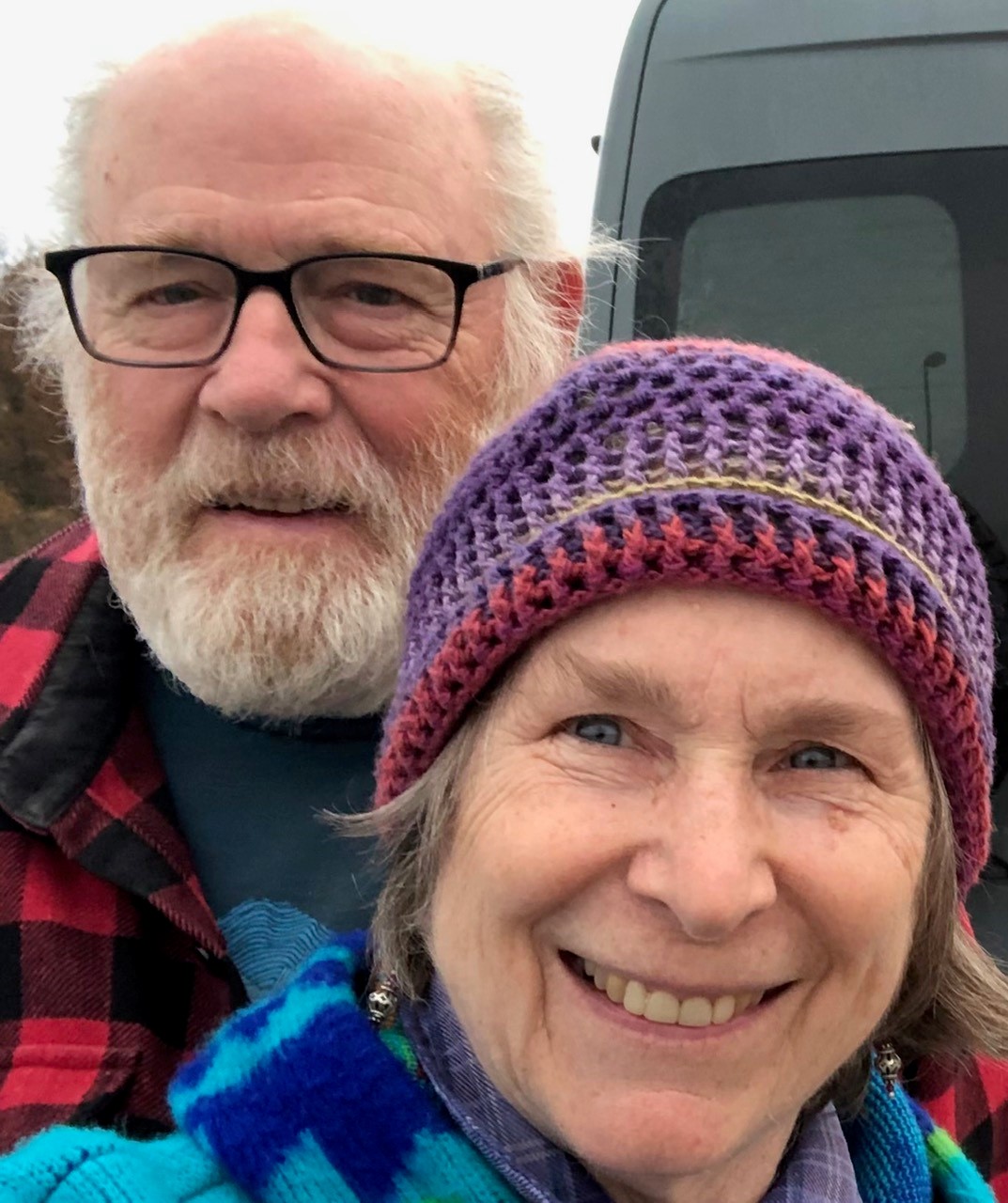
We are lifelong adventurers. I had been a serious climber and, for 15 years, an Outward Bound instructor/chief instructor, and Connie was a hardcore whitewater paddler. We met at the DirtFest mountain bike festival in May of 2012. Both of us were bound for other major adventures, Connie to the Arctic Ocean via canoe, me intending to ride all the epic western MTB trails.
We planned to ride the Tidewater Challenge MTB race upon our return in the fall, and Connie met me in Williamsburg, VA, the day after I returned from the West. Hurricane Sandy intervened, postponing the race for two weeks and preventing her return to NJ. By the end of those two weeks, the hook was set, and we have been together since. We traveled for five or six months at a whack for a couple of years, and on May 17, 2015, we rolled out for full-time life on the road.
The best way to follow us is to catch us rolling through your town and fall in behind. Be ready for a rough ride, as we have a penchant to follow sketchy two tracks that may catch our eye.
to open the company's website.