





No products in the cart.

Kevin Ophoff
November 21, 2025
175 views
How to Drive an RV in the Mountains
Having lived in Colorado for decades, my vintage motorhome and I have made numerous treks over the Continental Divide and other high-country passes. RV owners frequently post questions and concerns on Facebook and Instagram about safely navigating the ups and downs of mountain driving. Knowing the basics of power, braking, towing, and safety can make the difference between a great trip and an unfortunate experience.
Even though some of my experience is about driving in winter conditions, I DO NOT recommend driving a motorhome in the mountains when there is even a dusting of snow. A dusting of snow where you are, may mean there is much more snow where you plan to travel, especially if you plan to go into higher elevations. Rear-wheel drive vehicles are just not good on ice, period.
In Colorado, you can and should check with the Colorado Department of Transportation’s app COTrip.org for current road conditions before setting out. Other states have similar apps or websites for monitoring road conditions.
Uphill or Downhill: Both Require Knowledge and Skill
We’ll tackle driving uphill first.
Going Up: Your Engine Is Going to Work Hard
Countless flatlanders visit Colorado every year, hellbent on hiking or skiing, rarin’ to go. Within a quarter mile of heading up the trail, newbies are stunned to find themselves gasping for air, lungs on fire, muscles cramping, and hearts slamming against their ribcage.
Heading up the pass, your engine, like you, is silently screaming for mercy. Driving an RV or towing a travel trailer uphill stresses your engine. New or modern RVs and tow vehicles usually have enough power to handle the mountains, but ‘vintage’ motorhomes or those of us towing a heavy load might experience problems.
The last time we moved, I was driving the largest U-Haul truck they offer, up Slumgullion Pass, suddenly, BANG! Fluid sprayed all over the windshield, and warning lights blazed across the dashboard. My wife, following behind, was enveloped in billowing white and gray smoke. And of course, we were in the middle of nowhere. No cell phone or internet coverage for miles. So, I kept driving.
Eventually, we discovered that a fluid reservoir had become so over-pressured that the cap had blown off. Lucky for us, the truck kept chugging along, and we coasted into the tiny town of Creede. U-Haul sent a tow truck to retrieve our moving truck, which was eventually dumped in our driveway in Pagosa, Springs. We were pretty happy to see our earthly possessions safely delivered to our new home.
Engine Overheating
So how do you keep your engine from overheating? Watch your engine’s temperature gauge when climbing long or steep inclines. If the needle moves into the red zone, turn the cabin heat on full blast to dissipate the heat from the engine. This will help cool your engine and may give you enough time to reach the top of the pass without overheating.
If you do overheat, you’ll need to pull over, pop the hood, and let the engine cool down. This could take hours. If you make it to the top, DON’T STOP. Coasting down the other side with the engine running will cool the engine much faster than stopping and idling. Address overheating issues before your next trip.
You might even want to add a transmission oil radiator. My motorhome has a tow package that includes a transmission cooler.
Check Your Coolant Before Heading Out
Caution: DO NOT OPEN THE RADIATOR FILL CAP WHEN THE ENGINE IS HOT!
Before leaving on a trip, it’s a good idea to check your coolant level and condition. Use an anti-freeze tester as shown here. NEVER open a hot radiator fill cap. Choose a time when the engine is cool to test. It is always a good idea to carry a gallon of antifreeze with you just in case you need to add some while on the road. Read the instructions, however. Most antifreeze needs to be mixed 50/50 with water for the best protection.
If you have a vintage motorhome, you should carry replacements for the hose sizes your rig requires. Alternatively, you can purchase a universal radiator hose kit that will replace many sizes of hoses.
Rapid Transmission Shifting
As your RPM slows, your automatic transmission will want to downshift. It’s supposed to do this. However, sometimes the extra power in the lower gear will allow you to speed up, and the transmission will shift back to a higher gear. Your drive train can sometimes begin a series of shifting down and up every few seconds. You’ll feel and hear the engine revving and lurching as this happens. Do not let this continue!
Slow down when the transmission shifts into a lower gear, or shift the transmission into manual mode so it stays in the lower gear.
Listen to your engine. Watch your tachometer if you have one. High RPMs is normal in lower gears, but there is a limit on what your engine can take. Ease off on the throttle until you find the RPM that keeps you moving forward but doesn’t ‘red-line’ the tachometer. Your speed might slowly reduce until you are just crawling along, but that’s fine.
If you do end up crawling along, be aware of the traffic behind you and note the Impeding Traffic Laws for the state you are traveling in. Also, turn on your warning flashers once you drop below 40 MPH on long climbs to warn drivers behind you that you are driving much slower than the posted speed limit.
Colorado’s Impeding Traffic Law
From Colorado's FindLaw website: “Under Colorado Revised Statute § 42-4-1103, it is illegal for a person to drive so slowly on a highway that it impedes or blocks the normal movement of traffic. This rule applies unless a reduced speed is necessary for the vehicle’s safe operation or required by law. Many other state have similar laws. Check the laws in the state you are driving in for the current information.
Key provisions include:
- Keep right: On roads with multiple lanes in the same direction, a slower driver must stay in the right-hand lane.
- Pull over: If you are traveling slower than the normal speed of traffic and a right lane is not available, you must pull off the roadway when it is safe to let other vehicles pass.
- Special I-70 rule: On Interstate 70’s six-percent uphill grades, drivers cannot go more than 10 miles per hour below the speed limit if they are impeding traffic. This rule does not apply if conditions, such as weather or traffic, necessitate slower speeds.
Pull off the roadway at the first available place where such movement can safely and lawfully be made until such impeded traffic has passed by.
Driving Down a Steep Mountain Pass in Your Motorhome or Towing an RV Trailer
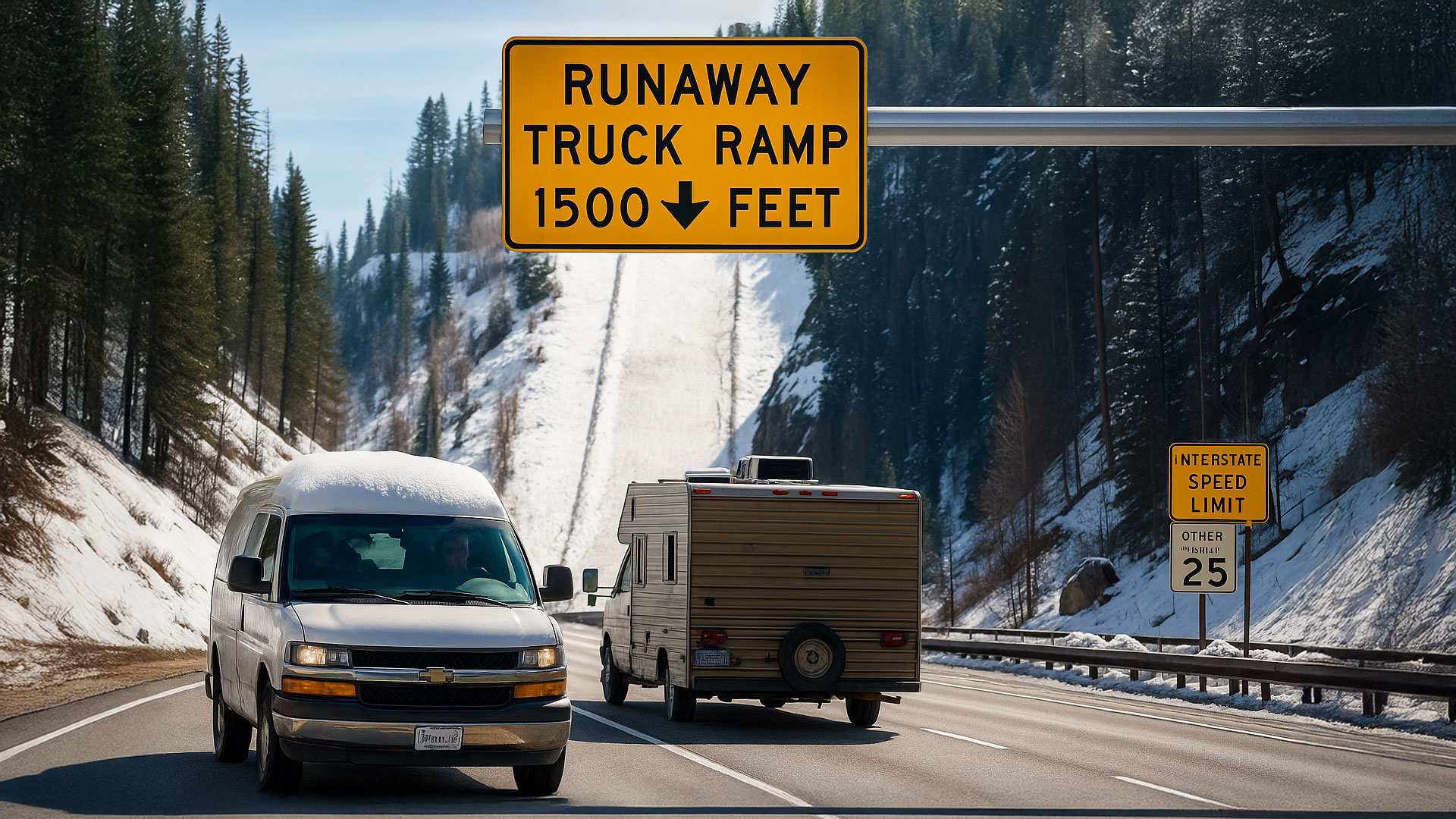
Now the fun part: plummeting! Otherwise known as driving down the other side of that steep pass.
Tip #1: Start Slow, Stay Slow
As you approach the top (or crest) of the pass, take your foot off the throttle and let the uphill drag bleed off your speed. Use as little throttle as necessary to get you to the top. Just as you level out, and before you begin to descend, take your foot off the throttle again. If your RV is equipped with engine brakes, engage them now. If not, shift down to a lower gear.
Tip #2: Downshift Into a Low Gear
Don’t depend on your automatic transmission to do this. Put the transmission in manual and downshift. Let your engine drag kick in and slow your speed without needing to use the brakes. Your speed should be between 35 MPH and 45 MPH.
Tip #3: Pump Your Brakes When Needed
Don’t ride your brakes. When your speed reaches 45 MPH, press your brake pedal and lower your speed to 35 MPH, then release the brakes. DRUM BRAKE PADS HEAT UP FAST. They can become white hot in seconds. Hot brake drums can lose their effectiveness and even start a fire. If you have a newer vehicle with disk brakes, which became common around the year 2000, heat is not as much of a concern.
By pumping the brakes, you give the drum brake pads a chance to cool down. This is the most important tip I can give you for driving an RV in the mountains.
Tip #4: Slow Down Before Sharp Curves
If you see a sign indicating a sharp curve ahead, slow down before you get there. Applying the brakes in a curve can send you into a spin.
How to Recover From a Spin-Out On a Tight Curve
1. Slow down before you get there. If you start into a spin, DO NOT SLAM ON THE BRAKES.
2. Take your foot off the accelerator and keep the steering wheel straight. Avoid over-steering.
3. If your vehicle has an electric trailer brake controller, manually and smoothly apply the trailer brakes only.
4. When the sway stops, pull over in a safe location to check your trailer hitch connection and tire condition.
Over-Correcting
Another common cause of RV spin-outs is dropping your tire(s) off the right side of the road onto the shoulder. A common reaction is to turn to the left as quickly as possible to get things back on the road. You naturally keep turning left until your tires grip and you climb back onto the roadway. Once back on the pavement, your car may go left very fast in the direction you’ve been steering. This over-correcting may send you flying into oncoming traffic, prompting yet another over-correction, this time to the right.
The correct way to recover is to stay on the shoulder and slow down before making any maneuver. Then pull your vehicle and trailer back on the road safely.
Watch this video of a semi-truck driver riding his brakes. The brakes lose their effectiveness, and he’s forced to use the Runaway Truck Ramp. In this 4-minute video by Brad Kinser, we watch an inexperienced trucker ride the brakes until they are useless. He was smart enough to use the Runaway Truck Ramp, saving his own life and possibly the lives of others.
In this 25-second YouTube® video by Savage Crash Videos, we watch a semi truck’s dashcam coming up the same pass. Just before reaching the hairpin turn, another semi truck (whose driver chose not to use the Runaway Truck Ramp) flies right through a concrete barrier, barreling over the side and falling hundreds of feet to the rocks below.
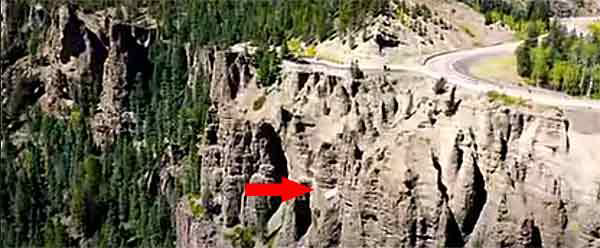
What Makes Wolf Creek Pass So Dangerous?
In this photo, a semi-trailer hangs precariously off a cliff on Wolf Creek Pass, Colorado. The cab is at the bottom of the cliff; unfortunately, the driver was killed. This is not the only trailer that remains wedged into this mountain cliff. Another reminder to be cautious on mountain passes, especially when driving downhill in an oversize vehicle.
A large motorhome or a truck towing a large travel trailer or 5th wheel, can weigh well over 10,000 lbs. They need to be driven like a semi-truck, lest they be prone to negotiating mountain curves.
This is the fear of inexperienced RVers. However, by following these suggestions, checking your brakes, controlling your speed, and paying close attention —everyone can successfully navigate these mountain passes and reach their destinations safely.
Towable RV Brake Systems
There are two types of braking systems used in towable RVs: electric and hydraulic.
Electric Trailer Brakes
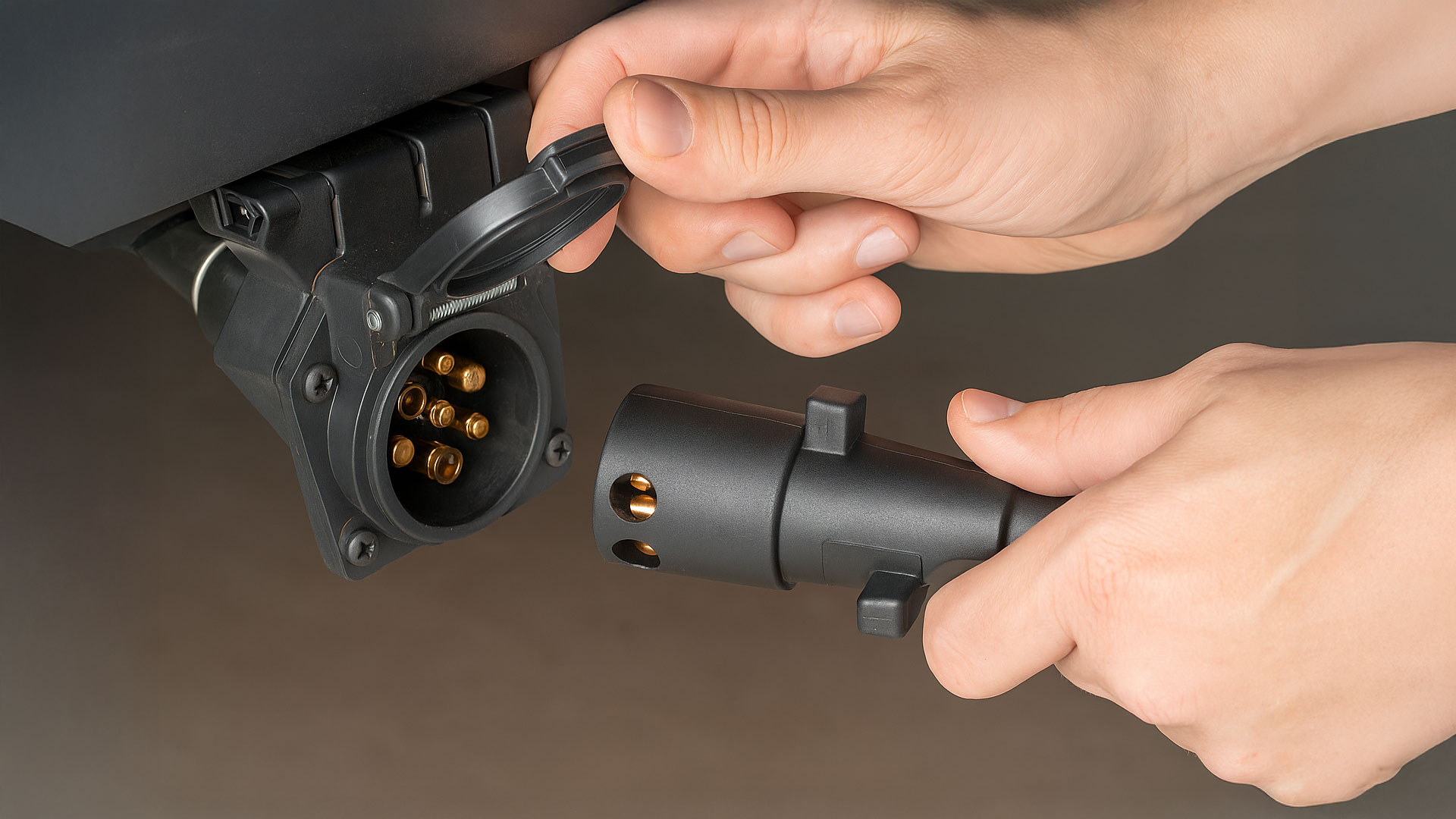
Electric Brake Connector
An electric current activates electric brakes through the 7-pin trailer connector. Keep the pins of the connector clean and check your brake lights before every trip. Visit this page of the Tiny Life Consulting website for details on cleaning corroded contacts on electrical connectors: Melted RV Shore Power Plug. How to Avoid Tragedy.
Hydraulic Trailer Brakes
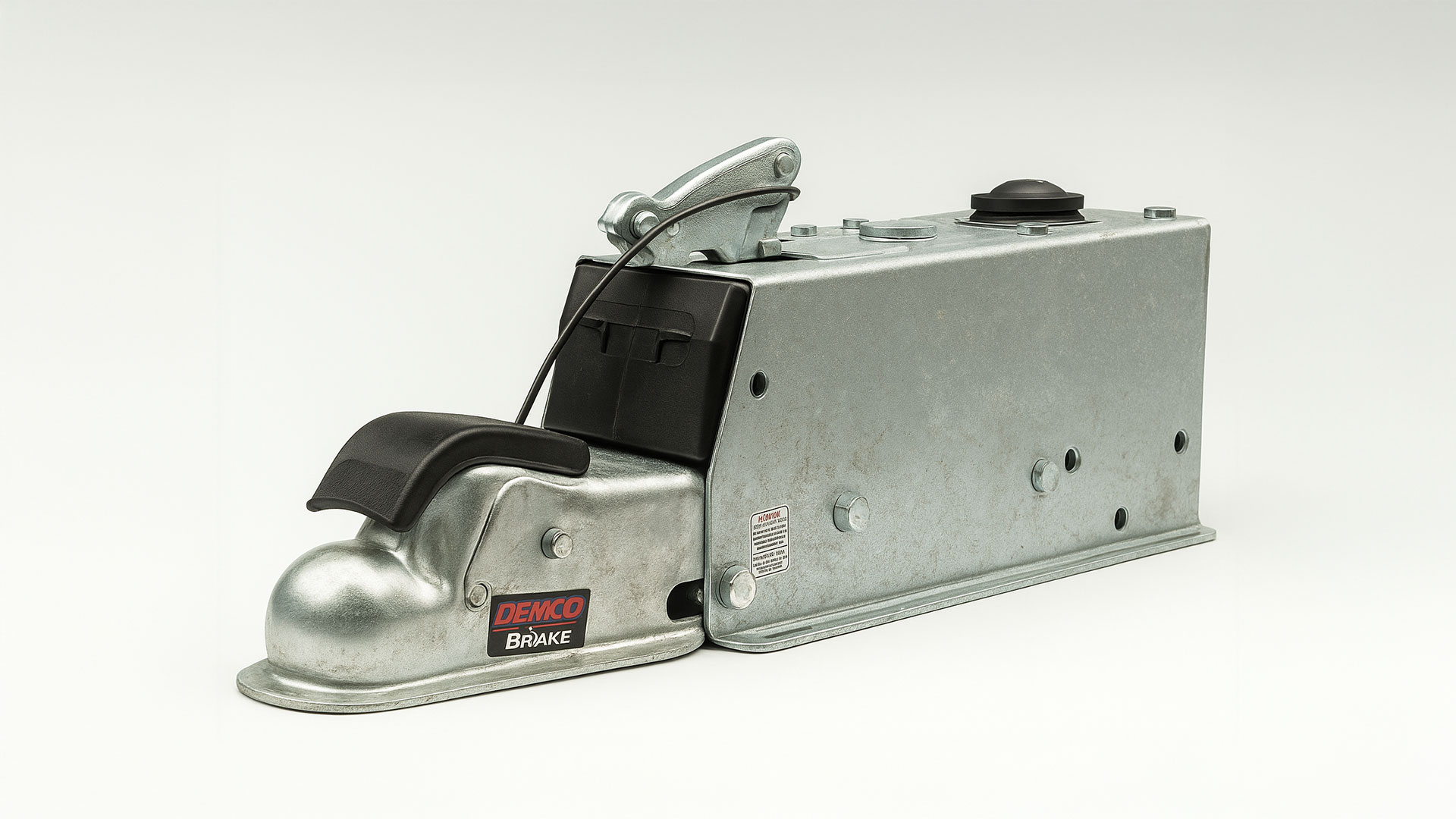
Hydraulic Trailer Brake Actuator
If you have hydraulic trailer brakes, you will recognize them by the hydraulic trailer brake actuator located on the trailer's tongue. When the tow vehicle slows down, the trailer’s momentum causes the actuator to slide forward, activating the trailer brakes via hydraulic pressure. When the tow vehicle begins to move forward, the pressure is released and the brakes are released.
There is a brake fluid reservoir in the actuator assembly that should be checked and filled, if necessary, before leaving home. This reservoir, or master cylinder, should have a complete fluid change every year or two.
The small cable hanging from the actuator serves as a brake actuator. It must be securely fastened to the tow vehicle's hitch mount. If the trailer unexpectedly detaches from the tow vehicle, it will activate the brakes and stop the trailer.
An Important Difference Between Electric and Hydraulic Trailer Brakes
Hydraulic brake actuators remain activated the entire time you are going down a steep hill. This prolonged, continuous braking can cause the trailer brakes to overheat, resulting in the brakes losing their effectiveness and potentially damaging the brake system due to excessive heat.
Electric brakes will not do this as they activate automatically and proportionally as you press your brake pedal.
Other RV Braking Systems
Jake Brakes are installed on many Class A motorhomes, trucks, bus engines. They use the engine’s compression to slow the vehicle. It’s usually activated with a simple switch on the control panel. If your Class A or bus has a Jake Brake installed, be sure to familiarize yourself with its operation before leaving the driveway. A Jake Brake is an integral part of the engine system.
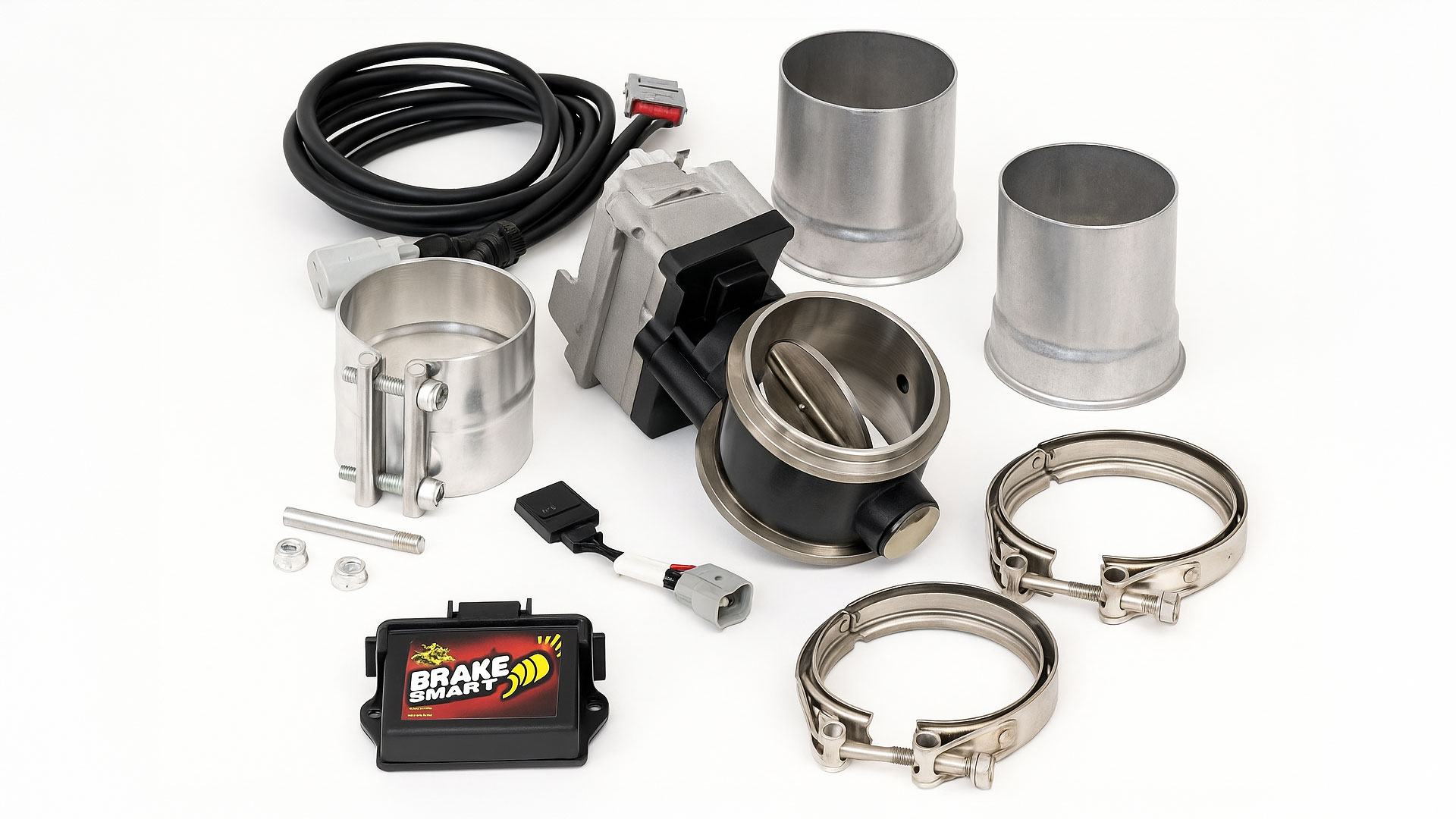
Exhaust Brake Kit
Exhaust brakes restrict the engine exhaust, creating a back pressure, forcing the engine to work harder against this resistance, which slows the vehicle down. These can be added after the market easier than a Jake Brake.
Specific Mountain Road Hazards
Be aware of these common road hazards in the mountains.
Animals
Animals like deer and elk are on the move at dawn and dusk. Dodge them if you can do so safely. We have installed deer alerts on every car we’ve owned so they hear us coming. We see them pick up their heads and notice us when we drive by. They are not expensive.
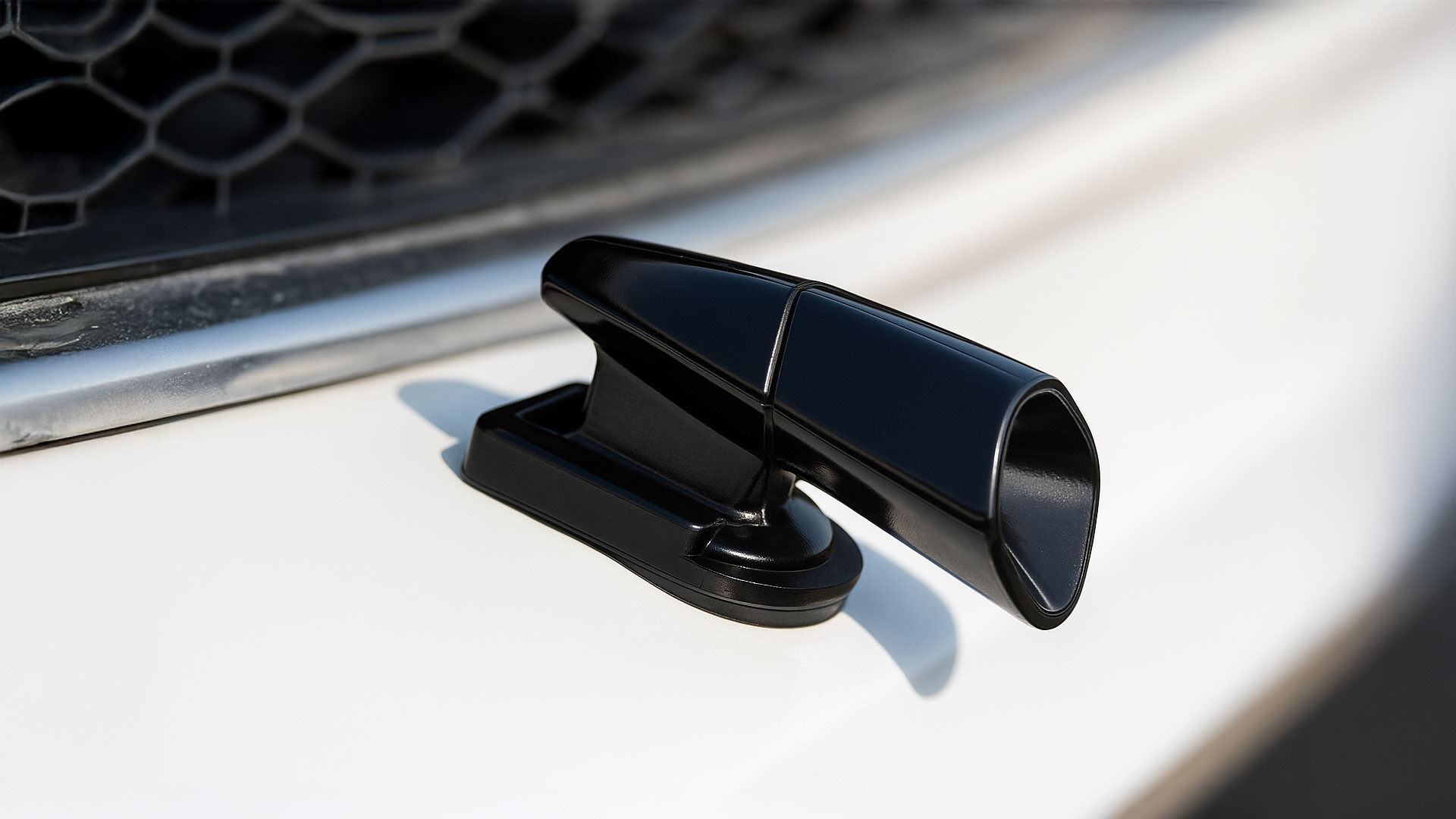
Deer warning whistles help keep these pesky critters from becoming roadkill. The ultrasonic whistle is inaudible to humans or pets inside your car, as it falls well outside the normal hearing range of people. They are easy to remove from the base when you need to go through a car wash, replace them, or make adjustments, etc.
Rocks and Mud in the Roadway
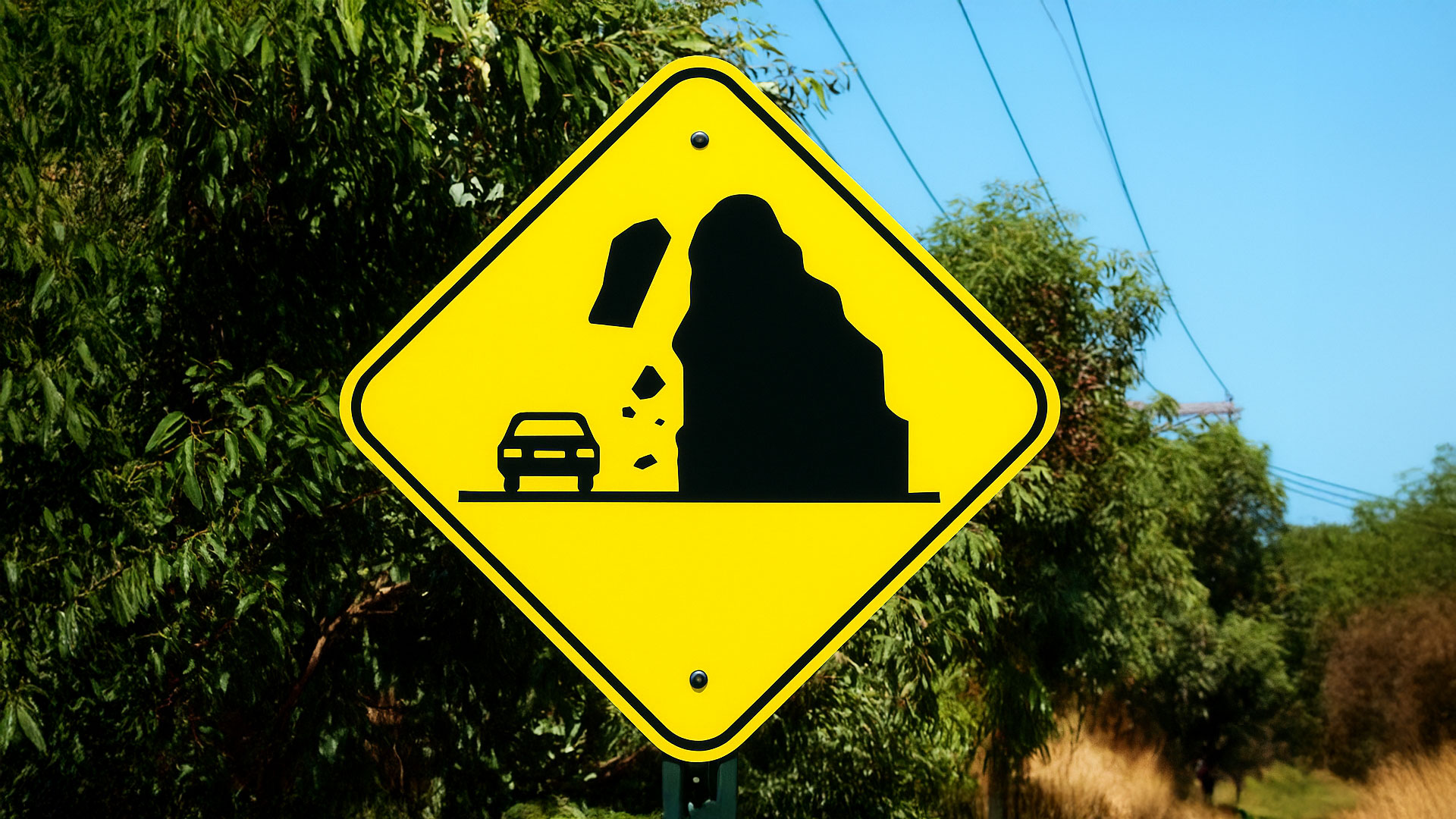
Falling rocks. When you see the sign, believe it. Wherever roads cut through mountains, there may be exposed rocks. Heavy rain, as well as freezing and thawing, can loosen rocks, causing them to crash onto the road. The Department's of Transportation do everything they can to mitigate the risk, but often that is not enough.
Mudslides, especially near wildfire burn scars, are also common. Keep an eye on the weather. “Know before you go.”
If you are in Colorado, visit CoTrip.org to check your route for hazards and construction delays.
Use a good app like RV Life Trip Wizard to plan the best route.
High Crosswinds
Your RV, whether towed or driven, is susceptible to crosswinds. A gust of wind can easily cause your rig to change lanes or even tip over.
The RV Life Trip Wizard app has an RV-specific planning tool that includes a wind speed feature under its “Weather Layers” in map settings. This allows you to proactively check wind conditions for your planned route, helping you avoid high wind areas or regions.
The Scenery Is Awesome
Yes, we know you want to gawk out the window, but you must keep your attention riveted on the road. Pull off at the provided areas to take in the view and snap a few pictures. If you can’t keep your eyes on the road, let someone else drive.
Mountain Passes To Avoid
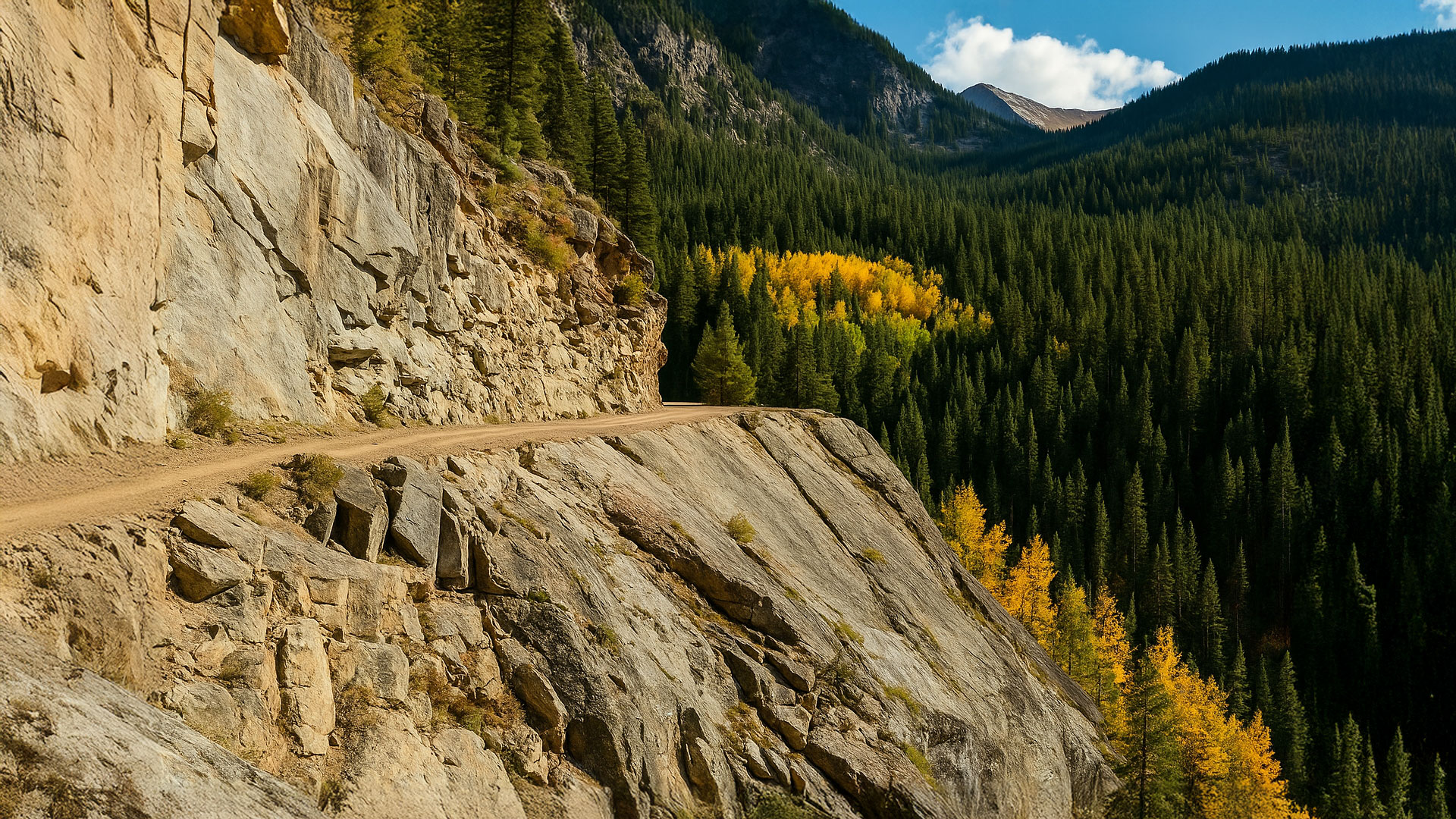
There are a couple of Colorado passes I’d never do again in an RV.
Independence Pass
Independence Pass, or Colorado Highway 82 between Aspen and Leadville, should be avoided by anyone in a large RV or when towing a camper trailer. Not because it’s so steep, though it is, and not because of the hairpin turns (there are many), but because of the narrow road on the Aspen side. There is a spot that is one lane wide, on a blind curve, where the cliffs above hang out over the road so low a camper can’t get underneath. There are no guardrails in this area either.
Vehicles over 35′ in length are prohibited. You’ll probably be OK in a Class B, or a pickup truck with a camper on the back.
Cottonwood Pass
I-70 through Glenwood Canyon closes frequently. The only alternative is to drive all the way up to Craig, then back down to Rifle. Google Maps has mistakenly sent travelers over Cottonwood Pass instead. This unimproved mountain pass between Eagle and the Frying Pan Road looks good on paper, but don’t do it. You might make it if you have an AWD truck with a heavy-duty trailer like the AUSRV overland trailer.
Final Thoughts
You can do this. Follow the tips on this page and you’ll be fine.
More pages of the Tiny Life Consulting You’ll be interested in:
Melted RV Shore Power Plug How to Avoid Tragedy
How to Repair and Remodel an RV
How to Drain and Maintain Your RV Holding Tanks
Best Air Conditioners for RVs and Tiny Houses
Running RV Appliances Like Air Conditioners Off-Grid
Roamly RV Insurance Compared to Progressive
Enjoy this YouTube® video of RV Fails.
Article written by Kevin Ophoff
Kevin Ophoff and his wife/editor Rachel Ophoff have been writing the Tiny Life Consulting website since 2018. Now, with over two hundred pages and posts of free information on tiny living, including all types of tiny homes, it’s one of the best resources of its kind.
Kevin researches topics extensively to point readers to the best information and products related to their area of interest.
An avid RVer, he’s maintained his vintage motor home well over the decades. His degree in aircraft electronics has been a solid foundation through a career in managing an electronics store and later in their home electronics installation company.
To be the first to read all new articles and to read thousands of articles about conversions back to 1992, become a member of BCM.
Click HERE to become a Member now!Click on any image in this column
to open the company's website.
to open the company's website.
