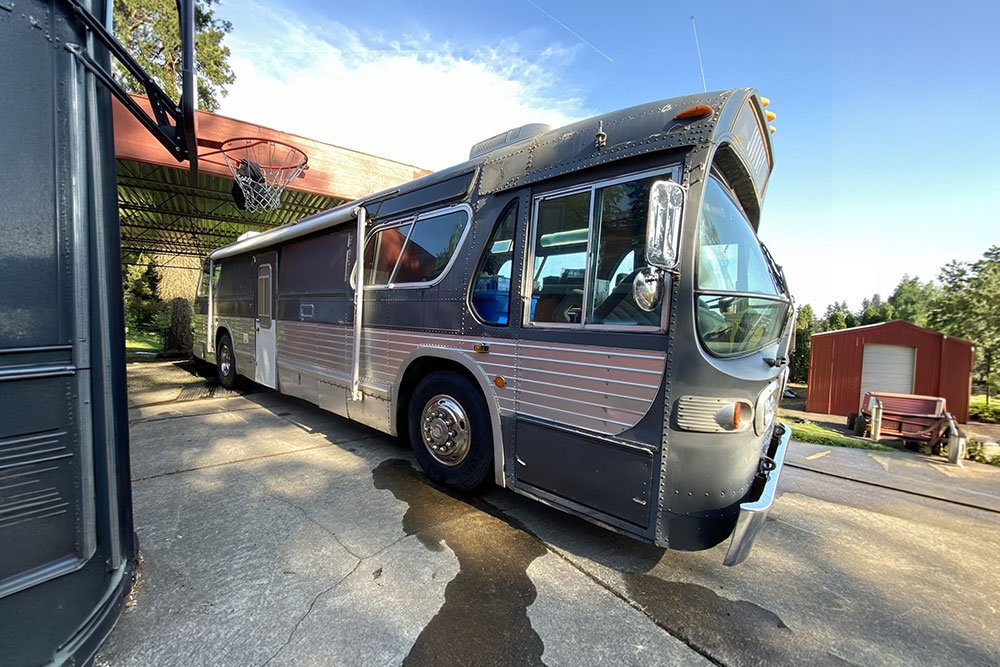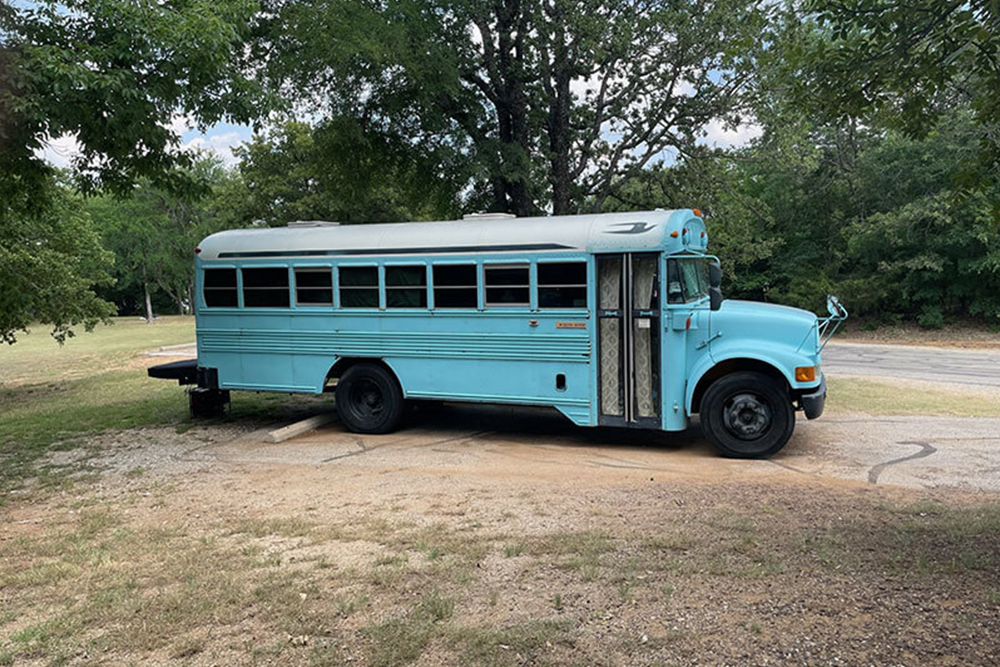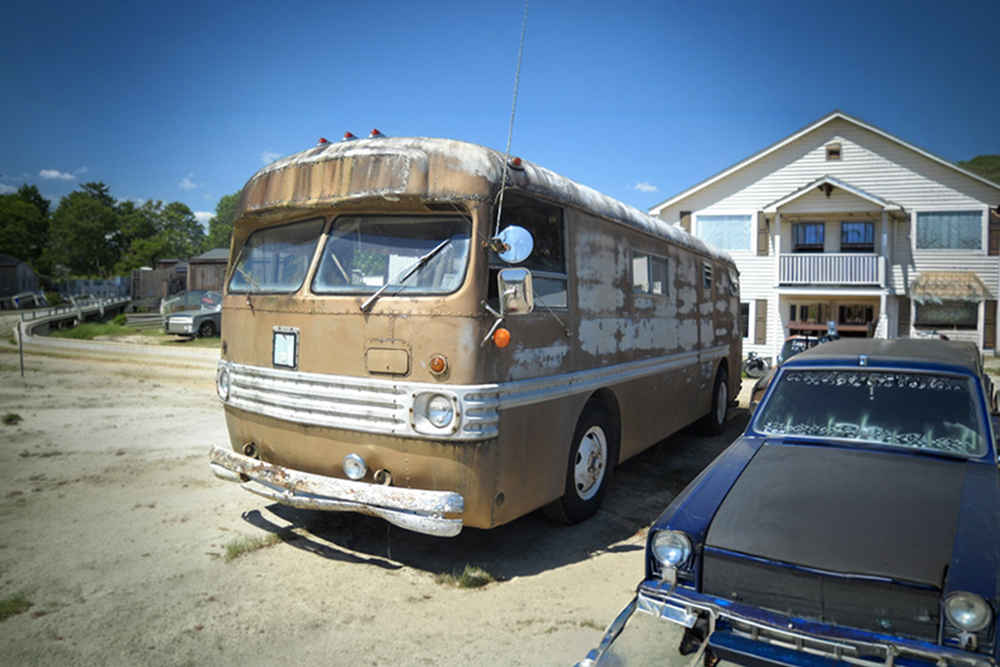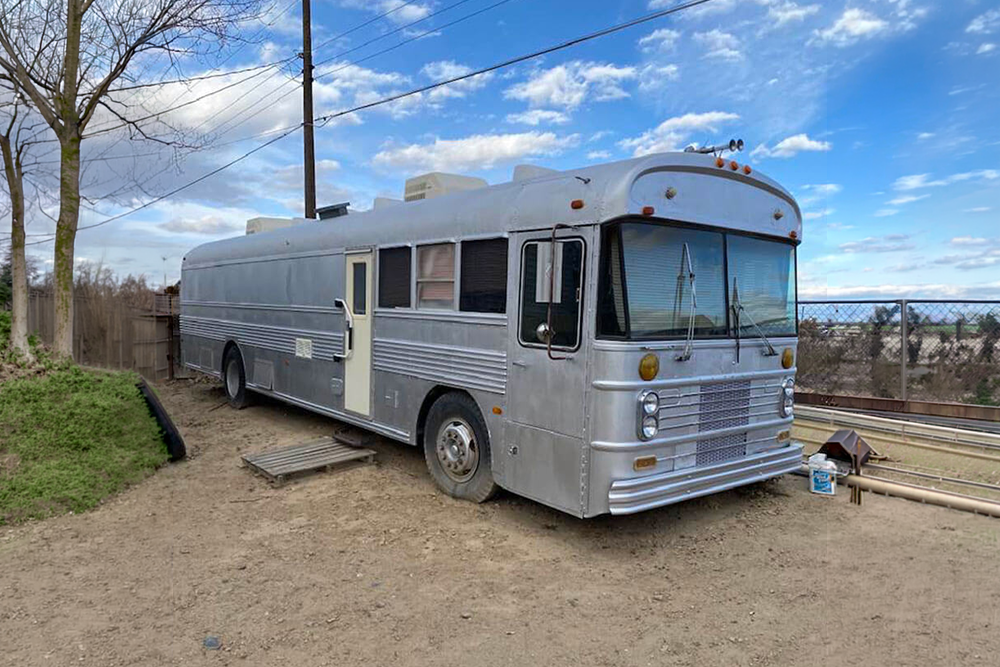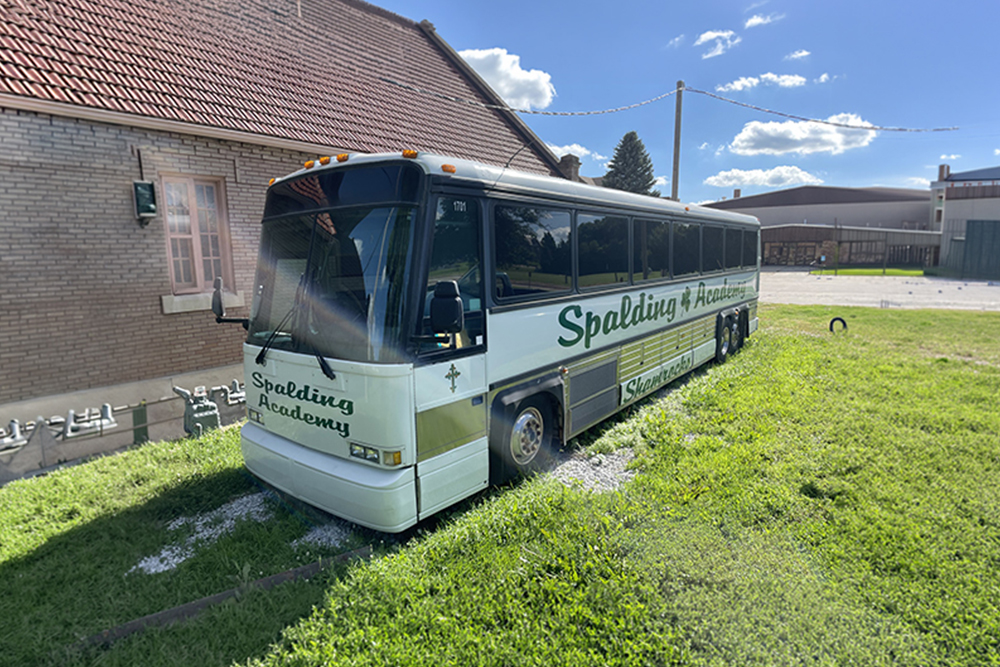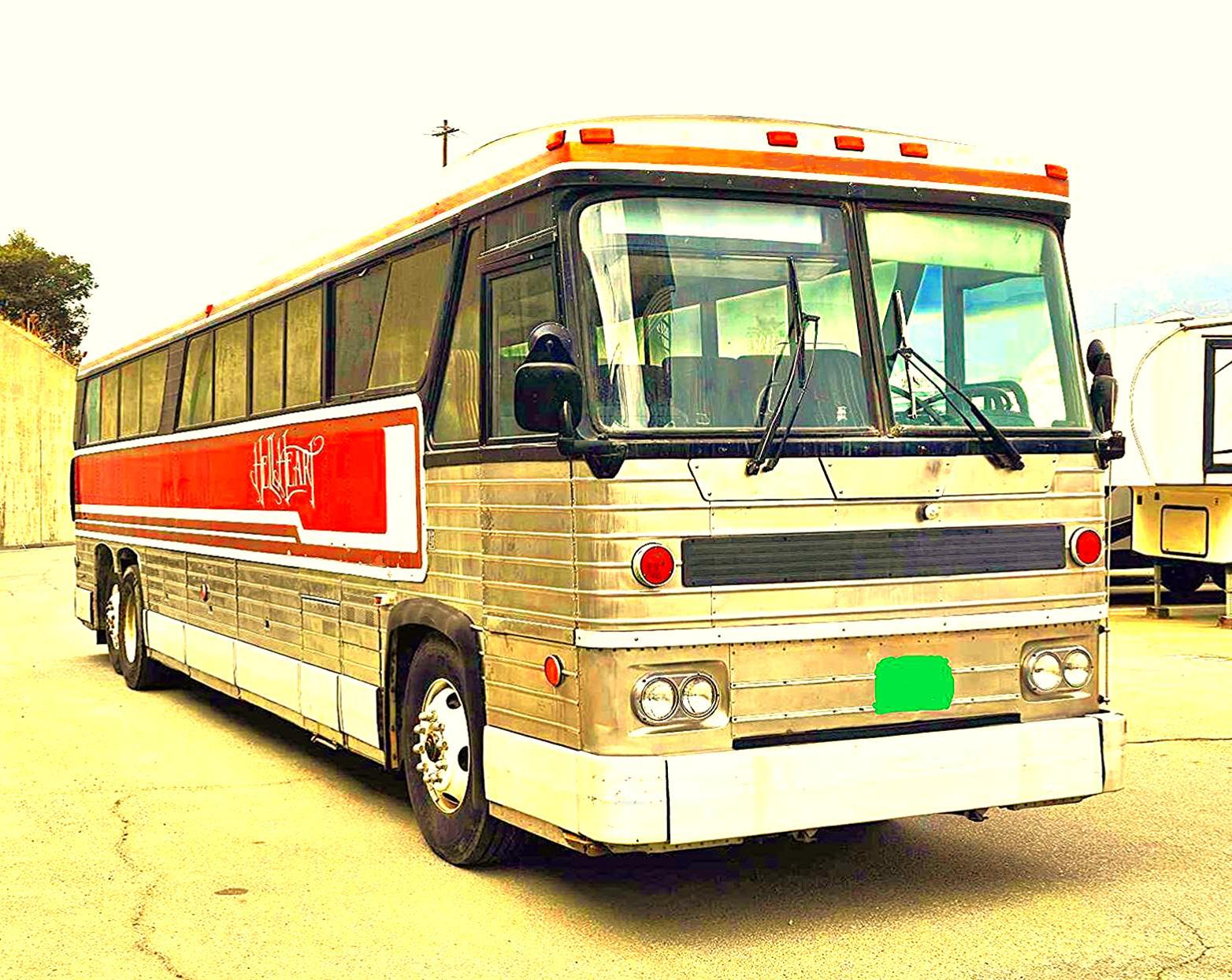























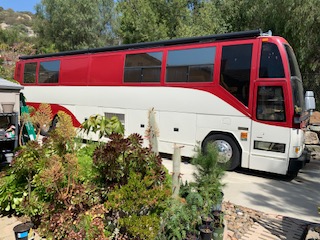
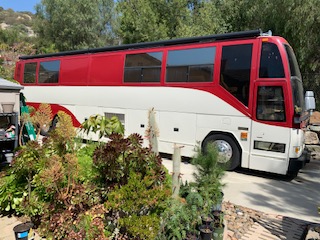
41-foot x 102" wide.
Detroit Diesel, series 60, Allison B500. It had 394,000 miles on it when I bought it, it has 430,000 now. The transmission was rebuilt at about 425,000 miles. I run synthetic oil in it, and Academy bus who originally owned it also ran synthetic.



The exterior is fiberglass. I had it painted with urethane paint and clear coat.
I have Alcoa's and Michelins all the way around. Chrome Hadley air horns on the roof with a great low pitched sound. The small solenoid needs replacing.
Lateral arm awnings all the way around, remote controls for all, with anemometer (disconnected) so they automatically close with wind speed above 22 mph. I also have a separate power switch so they cannot open while under way. Full 10’ awning the length of the bus on the passenger side, window awning 5’ on the driver side, the length of the bus. Mounted on the roof, they obscure the other junk I have up there so all you see from the side is a clean roof line.
The windows, tinted, mirrored, open with screens (insulated glass), as well as tilt open to allow more air, or to install large items like the refrigerator, bed, or large cabinets.
Webasto unit (actually the 41,0000 btu Espar unit the bus came with) for coach and cargo bay heat, engine pre-heat, and domestic hot water. Neither the Espar unit nor the heat exchangers are currently hooked up, although I do have the units, hose, and expansion tank. with two level fans blow heat from upper stairs forward, under the couch on your feet, under dinette on your feet, by toilet on your feet and on both sides of the bed.
Wrico GenSet, 13kW, big enough to do it all, not so big as to be hard on the engine or use too much fuel, or take up too much space. I don’t think anyone but a rock band needs a 20k. The genset is surrounded by a quiet box, and the radiator is mounted remotely. All maintenance functions can be done on the side mounted genset by removing a large access panel. The generator stays in place without having to move or slide it. The exhaust is routed up through the roof, both for sound attenuation and sending the exhaust fumes skyward and not toward a neighbor. Requires no set up, just start and run it.
It has a 115-gal grey tank, 58 gallon black tank and 160-gal Fresh water as well as a 10 gallon hot water heater for domestic use. It’s a dual heat version that has a 1500 watt electric element as well as a heat exchanger so I can use the Espar. There is some storage space left and I carry one of Jim Shepherds great fire extinguishers here as well as a tool box.
Fuel tank is stock 235-gal, I can drive from San Diego to Canada on one tank.
Three low profile, Carrier airs. One is just above the refrigerator (that has the coils on the top) and blows forward and back. The two ducted airs have remote controls with thermostats that also control the Espar heating system.
(1) 4000 watt inverter, with lithium Ion batteries at 24 volts. I can hook up an exterior water source, or use from my tanks. When I fill, I can either fill from the large filler neck, or by attaching a hose to an inlet that is low and in another bay where water escaping does not create issues. Have it set up so a buddy can attach his hose and either use my pump as his pressure line, or just fill his tanks. I have a faucet in the water / waste water bay with hot/cold water and a soap dispenser if I get my hands dirty.
50 amp, 30 foot shore-power electrical cord with line testing function to insure no faulty grounds or reversed polarity – prior to turning on power pole power to the rest of the coach and all its sensitive electronics, microwave etc. I have several adapters so I can plug into any style or capacity plug. demand is taken from the batteries which are in turn recharged by the inverter (or solar panels) when demand drops. I have a large double diode in a finned heat sink that isolates the house and bus start batteries, but allows the big 300 amp bus alternator the fully charge each set. I always arrive at my destination fully charged.
2 fully open cargo bays 44” x 44” by 8 feet. Lots of 120 volt electrical outlets in the bays, as well as lights when the doors are open. (can be disabled for when I leave the bay doors open for long periods). Lights run off house batteries. Nothing but the engine runs from the start batteries. I have a 30 foot, 12 gauge electric cord. I have a spring load reel for an air line that can be hooked to hook up an air compressor and can switch between that and bus air.
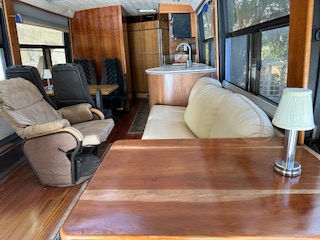
I have carpet on the entry stairs, engineered hardwood on the floors from the front to mid section.
Air ride, ultra-leather drivers seat and co-pilot seat. I kept the original bus “desk” in front of the copilot, but covered in cherry wood.
Stereo cabinet behind drivers seat.
Privacy curtain from windshield, covering access to coach interior.
Cherry wood cabinets and walls everywhere. Rear sleeping area with Queen bed that lifts up on gas shocks for access to large storage area underneath. Bed is 18” tall for lots of storage. I installed two matching windows in the back to look out 360 degrees when parked.
Hinged access door that swings back to cover part of the closet.
Bathroom, center walk-thru type. Bath includes classy tiled shower, glass door. The bathroom sink is in the bedroom with good lights and mirrored vanity with storage inside. Cherry cabinet and top with designer blue glass bowl. China toilet with direct drop to holding tank, and very water thrifty while still good at cleaning skid marks.
Fantastic vent above toilet to remove bad smell and excess water vapor from shower. Heated floor. Main electrical panel is in a short side aisle. Water tanks, genset hours meter, solar panel control, amp hours meter, 12v, 24v, 120v fuses and breakers, Espar control.
Fantastic vent and fan above the microwave / convection oven and the stovetop to remove heat and or water vapor
Tile shower. Toilet has folding, sliding privacy “door”. Since the layout prevents looking from the front of the bus to the back, there are no doors.
Ultra-leather couch in front converts to double bed.
Kitchen with all-electric, super efficient 16 cubic foot refrigerator made by Sunfrost with two Danfoss compressors that operate on 12 or 24 volts. Since there are two compressors, there is no airflow between the freezer and the refrigerator thus providing less freezer burn for foods in the freezer and longer lasting food in the refrigerator – better than almost all home type refrigerators, and must more energy efficient. Refrigerator senses when the batteries are being charged and will turn on to take advantage of the supplemental power, thus saving power when on batteries only. The refrigerator needs to be recharged.
Advantium microwave oven, combination microwave convection oven, will run on just battery power. The coach is all electric, using large power supplies and efficient appliances.
2-Burner 110 volt electric cook top.
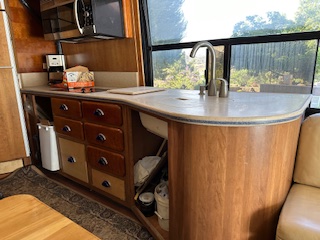
Large single bowl white Corian sink molded in to a curved Corian countertop with a small bump up on the edge to keep things from rolling off while parked. Matching curved solid cherry sink base. The sink has a cover that matches the counter top so the whole surface looks continuous and can hide things in the sink. Brushed stainless faucet with pullout spray and a squirt soap dispenser. Doors need to be made for under the sink as well as one drawer front.
Real hardwood floors in living area and kitchen.
Drawers and doors have catches or will close when brakes are applied.
No need to worry about acceleration opening things.
Built-in dividers in needed drawers.
Pantry storage with lights, 12 volt LED.
Commercial carpet in bedroom.
Seating to consist of 2 swivel chairs, 1 couch and dinette table with seating for 4, using 4 of the original bus seats. Very comfortable.
Couch folds out to turn into sleeping area.
Lighting in coach to be a combination of 12volt, 24 volt and 120vac. All exterior coach lighting to be LED .
Outside mirrors are heated.
Dump valves and are dump just in front of the rear wheels to maximize bay space.
Solar panels – 600 watts to house batteries and aux charge to coach starter batteries.






Place above driver for all bus books. Shop manual, parts book, conversion specifics, electrical system, Espar unit etc. Also a place for maps, driving directions, spare bulbs, relays and small replacement parts.

Qualify for a $200 Commission and a FREE 5-Year Membership or extension.
If you are working with any conversion parts or service companies, send us their information to support the only website dedicated to the nomadic conversion lifestyle.
We will contact them and if they advertise with us for at least six months, you will receive a free 5-year Membership and a $200 commission after they pay their first invoice.
Email their contact information to Gary@BusConversionMagazine.com
We are seeking a self-starter, energetic, honest person, with a pleasant phone voice to seek out new sales leads and follow up on current sales leads and then follow through and close deals.
This is a work-from-home/bus position and we are looking for someone who has some bus and/or bus conversion knowledge. This is a chance to earn money to either buy your own bus or money to buy materials to build your bus or tiny home, or to just earn some extra money. An interest in new and vintage buses and bus conversions is a plus.
All you need is a phone, a computer, a good internet connection, a quiet environment, and have a good working knowledge of MS products including, Word and Excel. You can work your own hours as many hours per week as you wish. The harder you work, the more you can earn. The sky is the limit.
You will be selling Advertising for up to three bus magazines
BCM, National Bus Trader Magazine, National Bus Tours Magazine, and Vintage Motorcoach Magazine
You can make one sale and potentially collect up to four commissions.
Contact Gary for more information a Gary@BusConversionMagazine.com or call the office to speak to him in person at (714) 614-0373.